Summary lesson quotes from the David C Cook Adult Teacher’s Guide
Week of October 12 through October 17
Something to think about this week: Your hidden talents
Daily Bible Readings
Mon. – Philippians 1:21-30 – Courage to Live or Die.
Tue. – Matthew 5:11-16 – Let Your Light Shine.
Wed. – Psalm 84 – Blessed Is One Who Trusts the Lord.
Thu. – Hebrews 4:11-16 – Let Us Strive for God’s Rest.
Fri. – Hebrews 6:1-12 – Promise of Better Things.
With the second of three lessons from Judges, we get the chance to read about one of God’s amazing rescues of the Israelites—even after they had turned away and served other gods. When they had made the choice to reject God’s blessing and live in the consequences of religious idolatry, the Lord did not neglect to bring deliverance from Moab and to restore peace.
Sat. – Judges 3:1-7,12-14 – God Tests His People.
Sun. – Judges 3:15-23, 30

Southpaw is the baseball term for a left-handed pitcher or hitter, widely regarded as having a strategic advantage due to the rarity of left-handed throwing and hitting.
Legendary southpaws who defined the sport include Warren Spahn, Sandy Koufax, Lefty Grove, Tom Glavine, and Clayton Kershaw.
Lesson 07 – October 8 – An Unlikely Deliverer
Do you remember standardized tests in school, the ones where every question had a multiple choice list of answers? I don’t know about you, but my strategy was always to reduce the possible answers first (so that I could choose from two rather than four).
Sometimes it feels like I’m in the middle of similar process with God. I see several possible directions to go, and then something changes. As days and weeks go by, options get narrowed (usually, my preferred path is first to go). Before long, being faithful means taking the only remaining path forward, or the opportunity that came out of nowhere.
In today’s reading, the Israelites are oppressed as a result of their sinful disobedience. Imagine the Israelite leaders brainstorming how they might defeat their captors, constructing their own “multiple choice” list of tactics: military assault, negotiation, paying someone off, etc. In God’s creativity and provision, He shows them that the answer is “D: None of the Above!” After all, who would ever suggest that God would raise up a southpaw (that means a lefty) and allow him to bypass security by sneaking a weapon into the enemy’s chamber? What a wild plan!
Several beautiful characteristics of God are evident in this passage. When we are suffering as a result of our own sin, God is gracious to deliver us. He is a creative God! The means of our rescue is often beyond anything we could dream up. Stand in awe of the God of unexpected and counterintuitive plans.
The book of judges records cycles of hardship: the people sin and rebel, God allows enemies to overtake them, the people cry out for rescue, and then God raises up a judge to deliver them. These judges were not necessarily like a judge today, but they were leaders whom God could work through to bring deliverance from enemies. The second cycle in the book of Judges introduces Ehud—the unlikely deliverer.
-The Israelites disregarded the covenant, and for eighteen years they have been oppressed by Moab.
-Finally, God raises up Ehud, whom the people choose to deliver their tribute.
-Ehud has special skills with a blade, and he conceals a short sword to bring with him.
-He gives the treasure to King Eglon, who has grown very fat at the expense of others who are suffering.
-Ehud has left the audience with the king of Moab, but something turns him around.
-He promises a secret “message” for the king, who seems eager to hear it.
-Ehud stabs and disembowels the Moabite king, then escapes.
-Through Ehud, God delivers Israel from this oppression and restores peace that lasts for a whole generation.
Expect the Unexpected
Ehud’s unusual (and graphic!) interaction with King Eglon shows how God often employs unexpected means to deliver us. In what area of your life are you crying out to God for deliverance? Is there a medical concern, a financial worry, a frustration at work, or a recent tragedy to bring to God? Lay it before the Lord, expressing your trust in the God who handles details.

Father, Thank You for showing us mercy, even before we have asked. You are faithful to hear our cries and respond with abundant grace. We need You to handle all the details that we don’t know to request. When we face oppression from the enemy, deliver us as You have promised to do. We ask this in Jesus’ name. Amen.
Week of October 5 through October 10
Something to think about this week: What is a disappointment that you have had a hard time putting in the past?
Daily Bible Readings
Mon. – Romans 5:1-10 – Christ Died for All.
Tue. – Romans 5:11-21 – Grace Abounds Despite Sin.
Wed. – Deuteronomy 12:1-14 – Worship at the Chosen Place.
Thu. – Deuteronomy 12:20-32 – Worship in the Chosen Way.
Fri. – Colossians 3:1-11 – Put On the New Self.
Sat. – Colossians 3:12-17 – Clothe Yourself with Godliness.
Sun. – Judges 2:6-15

Lesson 06 – October 11 – A Faithless Generation

You’ve probably heard the term “armchair quarterback.” Whether it’s judging your football team’s play from the comfort of your living room or offering unsolicited advice to a coworker who’s once again gotten himself into a jam, it’s the attitude that you would handle a situation better than the people actually going through it. I fall into that trap when reading Scripture sometimes. In today’s reading, the Israelites begin worshiping idols after forgetting the God who miraculously delivered them. How could they? I think. I would never dishonor God when He so clearly spoke His promise and showed His power.
The sad fact is, you and I could have behaved this way too. Faced with the scarcity of leadership and the fear of mighty enemies all around us, we might have felt the urge to follow gods we could see and touch, who offered us a sense of safety. It isn’t commendable or faithful, but it’s certainly understandable.
-After his final speech, Joshua lets the tribes return to their individual territories—an inheritance from God.
-Joshua was the kind of leader who inspired faithfulness in others.
-He and other leaders kept the nation from falling back into old ways.
-When Joshua dies, he is buried in Ephraim’s territory. No one takes his place.
-Since the generation that left Egypt and the generation that came into the land have both died, a third generation of Israelites comes up in the land.
-This new group of Israelites does not have Joshua to guide them. They do not know God.
-Instead, they serve the deities of other cultures around them and adopt their ways.
-God is aggrieved, and He gives them over to people who would take from them.
-The tribes of Israel cannot defend themselves or be safe without God’s help.
Pick One: Control or Blessing
We may look at the Israelites’ fatal attraction to Baals and Ashtoreths and be tempted just to shake our heads. Why? It’s easy to have almost the same reaction we might have to a loved one who is going back to an abusive partner. These foreign gods were horrible to serve.
Instead of God’s laws, which provided for the poor and vulnerable, other gods promised power and control. This kind of human religion makes a certain degree of sense from a fallen perspective. Normally when we want something, we feel the need to give in return. If we want something beyond our power (like rain to fall immediately or success against a terrible foe), then perhaps we might be asked to sacrifice what is dear to us, even a child. It is human to do terrible things to feel in control.
Yahweh, on the other hand, is not a God we control. God values our faith and a relationship with us. God enjoys giving what truly leads to our good, rather than satiating our desire for control. Jesus tells us that God’s grace is abundant, “[sending] rain on the righteous and the unrighteous” (Matt. 5:45). Serving our holy God means relinquishing our control in favor of what God desires.
We cannot chart a clean and reliable path to material riches if we follow Jesus. Following Jesus includes taking up a cross (Matt. 16:24). The new covenant comes with the most wonderful of promises, the fulfillment of the blessings that were offered to the Israelites in Deuteronomy. God’s eternal blessing is more valuable than what any other god or ideology can offer.
So when we read of all of the terrible choices in this era, we can rejoice that we see the fuller picture. We can learn the lesson of our ancestors in the faith, that if we reject God’s blessing, we are only harming ourselves.
Rejecting God’s instruction and ways leads to a destructive path, whereas following in His trustworthy ways and remaining faithful to Him leads to life, peace, and blessing.
Father God, We confess that it can be hard to trust the God we can’t see, especially when we’re surrounded by a world that offers us alternatives and easy answers. When we feel tempted to put our trust in idols rather than You, remind us of the stories of faith before us in the lives of those we know. In Jesus’ name we pray. Amen.
Week of September 28 through October 3
Something to think about this week: What is a vow or a promise that you have seen tested over time?
Daily Bible Readings
Mon. – Joshua 23:1-11 – Hold Fast to the Lord.
Tue. – Joshua 24:1-13 – Reaffirming the Covenant.
Wed. – 1 John 1:8-2:5 – Obey Christ’s Commandments.
Thu. – Luke 9:57-62 – No Turning Back.
Fri. – Matthew 22:34-40 – The Greatest Commandments.
Sat. – Psalm 25:12-22 – God, Deliver Your People.
Next Week: Joshua 24:18-27

A politicians promise
A politician visited a village and asked what their needs were.
”We have 2 basic needs sir,” replied the villager.
“Firstly, we have a hospital, but there’s no doctor.”
On hearing this, politician whipped out his cellphone, and after speaking for a while he reassured the village leader that the doctor would be there the next day. He then asked about the second problem.
“Secondly sir, there is no cellphone coverage anywhere in this village.”

Lesson 05 – October 4 – A Covenant Renewed
Joshua 24 is the last chapter of the book and a final opportunity for the successor to Moses to show wise leadership. The exhortations of Joshua 23-24 acknowledge the ongoing challenge of being the holy nation that God has called Israel to be.
-Joshua has assembled all the tribes and leaders at Shechem.
-He gives a final sermon to encourage them to commit to serving God.
-Though Israel’s ancestors were idol-worshipers, they are called to reject the religions around them.
-The people repeatedly agree and commit to the covenant expectations.
-The listeners want to choose the way of blessing, as Joshua had urged them to do.
-They recommit to exclusive worship of God, formalizing a covenant renewal.
-Joshua records everything in written form, and as a second reminder he sets a standing stone.
-This stone will be like a witness to the commitments that have been made.
Say No
A few decades ago, well-meaning politicians created a marketing campaign as part of the so-called “war on drugs.” You might remember it from its memorable posters, commercials, and other advertising that encouraged children to “say no” to using drugs. The hope was that sharing a. message with adolescents and children could persuade them to avoid going down a harmful path altogether. Yet most public policy experts consider the campaign unsuccessful. There has never been good evidence that the messaging altered individual behavior.
Joshua presented his own kind of “say no” campaign. “Say no” to religious compromise and adopting the worship of other gods. “Say no” to the grumbling that led the wilderness generation astray. “Say no” to becoming indistinguishable from the Canaanites. With the benefit of hindsight, we can add our voices of warning: Don’t fall into the trap that would lead to destruction!
Joshua seems to know that the road to obedience is narrow, that the people he was leading would not be able to keep their commitments. Without a designated successor, with many Canaanites left in the territory, with the force of gravity pulling the tribes back to past behaviors Joshua was right to worry.
But the situation is different for followers of Jesus. Whereas the Israelites had the same sin problem as their ancestors, the victory of Jesus means we have the opportunity to experience freedom from the enslaving master of sin (Rom. 6:18). Whereas the Israelites were led by the Spirit sporadically and through chosen leaders, we have the opportunity to be filled with God’s holy presence. The Spirit helps us to choose life, for “the Spirit gives life” (Rom. 8:10). The Spirit helps in our weakness, enabling our obedience.
Gracious God, We want to heed Joshua’s call to commit to serving You. Help us to identify the idols in our lives that pull us away from wholehearted devotion. We know that under our own power, we can’t overcome. But with the Spirit’s help, we can shed the things that will never satisfy, putting You first in our lives. In Jesus’ name we pray. Amen.
Week of September 21 through September 26
Something to think about this week: Ask yourself “When has God provided an ally in an unexpected place?”
Daily Bible Readings
Mon. – Joshua 2:1-7 – Welcoming Strangers.
Tue. – James 2:14-26 – Faith Without Works Is Dead.
Wed. – Psalm 67 – May the Nations Know God’s Salvation.
Thu. – Hebrews 11:1-2,29-31 – Faith to Live By.
Fri. – Acts 10:34-48 – God Shows No Partiality.
Sat. – Joshua 2:8-14 – Rahab’s Faith in God.
Next Week: Joshua 2:8-13; 6:16-17

So how does the person who’s new to the faith, or the person who has a different background than us, experience a lesson on Rahab?
We have to be careful not to make a person feel like an outsider. Rahab’s story shows that those who humbly come before God are not outsiders. Even those of us who grew up in a church community had to choose to make that faith our own.
Rahab’s story shows that God wants all people to come to Him, and He is faithful to those who revere Him. Despite not coming from the people of Israel, Rahab respected the God of the Israelite newcomers. She heard about the miracles and God’s protection of Israel; and she guessed (rightly) that God would protect her, if she turned to serve Him.
God wants each of us to choose Him, to be faithful to Him. How thankful I am to have a God who is faithful toward us as well!
Lesson 04 – September 27 – Rahab Welcomes Spies
Joshua is preparing for a difficult road ahead, and he sends two spies to the city of Jericho. This is actually before the people have crossed the Jordan River (Lesson 2). Sending spies into Canaan hearkens back to when Joshua himself was sent as a spy (Num. 13:16). Now Joshua is in the position of authority, and he has his attention set on one of the strongest and most fortified cities of the land. The two men are taken in by a woman named Rahab, who hides them from the king.
-Rahab provides Israel’s spies with safety in the city of Jericho. She sends the king’s men looking somewhere else so the spies won’t be found.
-Rahab recognizes that God has given the land to the Israelites.
-Already the people of Jericho have heard of God’s mighty works.
-They are afraid because of Israel’s powerful God.
-By her actions, Rahab recognizes Israel’s God as the Lord of heaven and earth.
-Rahab asks the Israelite spies to show kindness to her family and spare them.
-Later, the Israelites march around Jericho seven times.
-The priests sounded the trumpet, and Joshua commands the army to shout.
-God gives the city to the Israelites, and Rahab and her family are spared.
Celebrate God’s free invitation for those who have not yet placed faith in Jesus.
The invitation for today is to celebrate the merciful and faithful God who will welcome outsiders to His side. It is wonderful to know people who haven’t yet stepped through the door of faith, and they might already show generosity, kindness, joy, and deep love for others. We can use this week to hold these friends and family before God, to be grateful for what God is doing, and to pray for others’ faith.
Almighty God, We stand in awe of the way You work, even using those outside Your covenant to do good and to accomplish Your purposes. Open our eyes to the creative and unexpected ways You are using people and circumstances around us to build Your forever kingdom. May we all turn to You to save us. In Jesus’ name we pray. Amen.
Week of September 14 through September 19
Something to think about this week: What is a blessing in your life that can only be credited to God—not to you or your own abilities?
Daily Bible Readings
Mon. – Deuteronomy 7:1-11 – Live as Holy People.
Tue. – Deuteronomy 7:12-26 – God Will Love and Bless.
Wed. – Philippians 4:10-19 – Strengthened in Every Circumstance.
Thu. – 2 Corinthians 10:1-5,15-18 – Armed for Spiritual Warfare.
Fri. – John 16:23-33 – Christ Has Overcome the World.
Sat. – Joshua 10:40-11:5 – God Fights for God’s People.
Next Week: Joshua 11:6-9,16-23
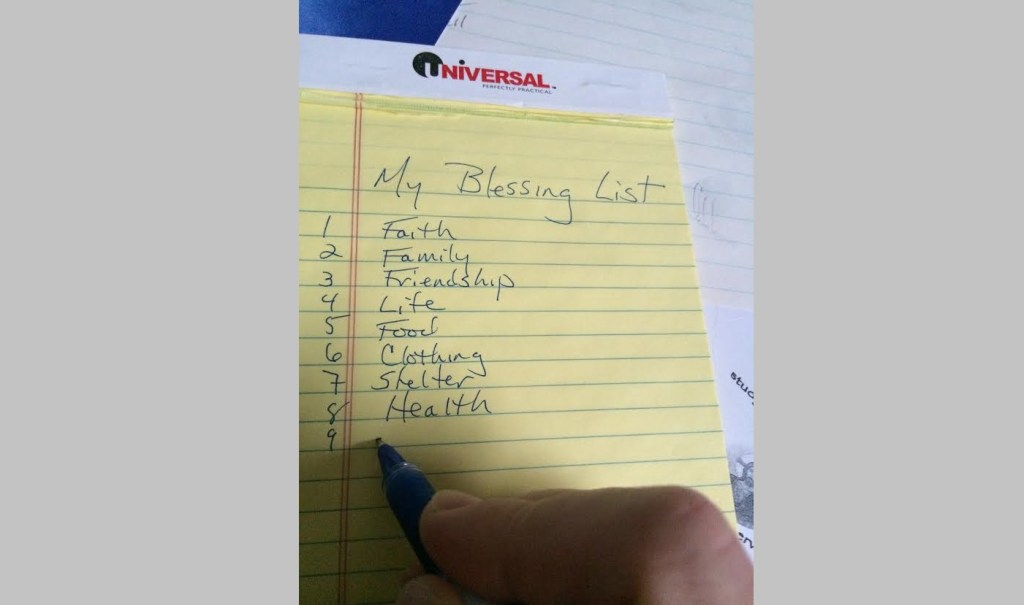
I tell her, “I really don’t feel like I can either, but I know God calls me to do it, so I just do it!”
I do not enjoy public speaking. It freaks me out. Give me a laptop and I can write all day long, but I am not comfortable in front of a group. Yet God has put me in situations where I have needed to do just that, so I pray for help. I ask for wisdom and strength, and I do it.
Have you done things you didn’t think you could do? It’s a wonderful thing to obey God when you don’t feel confident, and see blessings over your obedience. As the saying goes, “God doesn’t call the qualified; He qualifies the called.”
Lesson 03 – September 20 – Joshua Fights for God
When the Israelite tribes first enter Canaan, those able to fight are not supposed to settle down until all the territory has been cleared of people who would threaten or exert religious influence over them. The tribes with an inheritance east of Jordan must continue to stand together with their fellow Israelites (Josh. 1:12-15). Under Joshua, the united forces have taken two major strongholds (Jericho and Al), and now attention turns to territories in the north.
The first time that Moses ordered spies to enter the land of Canaan, they returned with fantastic reports of the land’s potential. However, all they could talk about were obstacles: “The people who live there are powerful, and the cities are fortified and very large” (Num. 13:28). None of that mattered if God was inviting them to take the territory! Psalm 2 says, “The kings of the earth rise up and the rulers band together against the LORD and against his anointed” (v. 2). No matter the odds, God is more powerful.
But when God uses us, we are constantly tempted to make a show of our involvement. We stand on our abilities and our strength, forgetting that God alone can provide these in the first place. We read today about a demonstration of epic proportions, when God asked Joshua and the other Israelites to go into battle without a single horse or chariot. Were I in their shoes, I might have called that crazy!
We can put all of our energies into the battle against evil emptying our storehouse of reserves and still it would never be enough to overcome the enemy we face. Only with faith can we hope to “extinguish all the flaming arrows of the evil one” (Eph. 6:16).
Here is how to make this truth practical. First, if God invites you to do something extraordinary, don’t dismiss what seems too hard. Second, when you look back at a lifetime of struggles against opposing forces, assume that your skills and abilities didn’t make the difference. Finally, don’t go into your “battles” alone. When struggles are against evil, you need God to be your bulwark, His strength to be your hope. Invite others to join you in prayer and discernment, as you ask God to show faithfulness and protection.
God, You are wise beyond our comprehension, more powerful than any enemy. Where we have given a foothold to evil, we ask You to be our fortress and help. Where we have seen only obstacles, let us see the hope that You bring. Give us the courage to invite You to fill us entirely, leaving in our hearts no space for darkness. We pray in Jesus’ name. Amen.
Week of September 7 through September 12
Something to think about this week: How do you keep the memory of family traditions alive?
Daily Bible Readings
Mon. – 2 Thessalonians 2:13-17 – Hold Fast to the Teachings.
Tue. – Exodus 14:21-31 – Victory at the Sea.
Wed. – Numbers 10:29-36 – The Lord Goes Before Us.
Thu. – John 6:15-21 – Do Not Be Afraid.
Fri. – Psalm 77:10-20 – Remember God’s Mighty Deeds.
Sat. – 1 Corinthians 11:23-27 – Remember Jesus’ Saving Work.
Sun. – Joshua 4:14-24

Lesson 02 – September 13 – Israel Remembers God’s Deeds
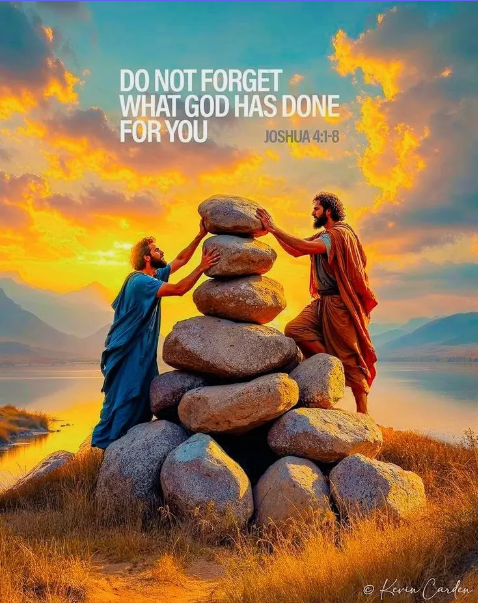
Remembering God’s Faithfulness
For decades, my dad has kept a prayer journal. But after writing his requests, he always leaves some space. When God answers those prayers, my dad flips back in his journal to his request, and in that blank space writes every detail of how and when God answered it.
And wow, does he remember God’s faithfulness! He recalls distant memories of what God has done in his life and in the lives of others. He connects the dots to find answered prayers in unexpected places. But as someone who doesn’t keep a journal, I struggle to recall all of the goodness God has shown me. Even my most difficult struggles can, over time, fade from memory. How easy it is to forget what God has done! If Israel needed a monument of stones to remember the Jordan drying up, how much more do we need reminders of God’s work, both large and small?
The twelve stones at Gilgal served as a memorial, reminding future generations of God’s faithfulness. This theme of remembrance carries into the New Testament. The writer of Hebrews encourages believers to remember when God had sustained them through hardship, so that they would persevere in the present (see Heb. 10:32-36). Peter reminded believers of their calling and election so that they would “always be able to remember,” even after his death (2 Peter 1:12-15). Remembering is key to perseverance.
As believers under the new covenant, we, too, need to remember God’s saving acts. When we participate in the Lord’s Supper, we do so in remembrance of Jesus’ sacrifice. But that’s only one example of remembrance. Whether through the formality of a prayer journal or through ordinary items (a sticky note with a verse, a favorite piece of artwork, a picture), we should always find ways to remind ourselves and others of God’s faithfulness.
Lord Jesus, We remember that we are Your people, and that You gave Yourself to be our salvation. Help us to live with Your love before our eyes. Help us to trust that the some God who led His people across the Jordan will lead us through our hardships. We praise and thank You in advance for Your deliverance. In Your saving name we pray. Amen.
Week of August 31 through September 5
Something to think about this week: Places make you want to welcome God to be with you
Daily Bible Readings
Mon. – Romans 8:31-39 – More Than Conquerors.
Tue. – Genesis 13:14-18 – See What God Has Promised.
Wed. – Deuteronomy 34:1-12 – The Promised Land Revealed.
Thu. – Hebrews 4:1-11 – God’s Promised Rest.
Fri. – Hebrews 10:14-18 – God’s New Covenant.
Sat. – Psalm 27 – Whom Shall I Fear?
Next Week: Joshua 1:1-11

Focusing on God and His presence with us, rather than on our challenges or circumstances, helps give us the strength and courage to walk forward. What is unknown to us is not unknown to God. No matter what we face, God’s wisdom, provision, and strength are already present and sufficient.
Lesson 01 – September 6 – Joshua Leads Courageously
After forty years in the wilderness, the people of Israel are finally ready to enter the land of Canaan. Yet Moses, who led them all those years, is gone. The responsibility of leadership falls to Joshua, Moses’ apprentice throughout the wilderness journeys. God had deemed Moses unfit to enter the promised land (Num. 27:13-14). How will Joshua measure up?
No two generations of people are the same. The “silent generation” was raised during the Great Depression and World War II, when not many were having children at all. With early memories shaped by economic and social hardship, many grew to be the stereotypical rule-followers and people who remained careful with their resources. Maybe you relate, or you know people like that.
Now imagine a whole generation of people born and raised while wandering the desert, searching for safety and sustenance. In contrast to memories of abundance in Egypt, the generation approaching Canaan had only experienced life on the road and under duress. But with Moses—the leader who performed miracles and spoke to God—they had a consistent person at the helm. Moses faced his share of troubles, but he had seen it all.
Generational transition always feels premature. Like Joshua, maybe you feel the weight of change. Maybe you have some big shoes to fill. Or, maybe you are in the position of mentoring and training others. What stands out about Joshua is that God had been preparing him for the moment for forty years, and yet Joshua still needed reassurance. Isaiah 41:10 is a wonderful promise to claim for these daunting situations: “Do not fear, for I am with you; do not be dismayed, for I am your God. I will strengthen you and help you; I will uphold you with my righteous right hand.”
Lord, You know what lies before us in the days ahead. Some of us will face decisions or challenges that will stretch our faith. Help us to be strong and courageous, knowing that You go before us into every situation. May we remember that we’re never alone, and that we can trust You to provide everything we need to navigate the road ahead. We ask these things in Jesus’ precious name. Amen.
Week of August 24 through August 29
Something to think about this week: How do you give or receive hospitality?
Daily Bible Readings
Mon. – 1 Peter 4:7-11 – Use Your Gifts to Serve.
Tue. – 2 Kings 4:8-17 – God Rewards Hospitality.
Wed. – Proverbs 31:10-22 – A Capable, Entrepreneurial Woman.
Thu. – Matthew 25:14-23 – Good and Faithful Servants.
Fri. – Matthew 25:24-30 – The Wicked Servant.
Sat. – Job 31:16-28 – The Righteous Provide for Others.
Next Week: Acts 16:11-15, 40

Hospitality is a dying art in our word today, making it an even more special gift to give. Think back to a time when you were welcomed into someone’s home and they went the extra mile to make you feel comfortable and cared for. Do you remember that feeling? Maybe you felt honored.
Lesson 13 – August 30 – Lydia, Generous Host
After staying in Philippi for several days (v. 12), Paul and his companions walk to the river on the Sabbath. When he entered a new city, Paul followed a principle of preaching to his fellow Jews before sharing the gospel with Gentiles (Acts 28:17-31; Rom. 1:16). Paul usually visited the synagogues, Jewish places of prayer and study (Acts 13:5, 14; 14:1; 171, 10, 17 18:4, 19; 19:8). These meeting houses would give Paul the opportunity to find lodging among his fellow Jews. However, synagogues were expensive to build, and towns with smaller Jewish populations often used other spaces to gather.
In Philippi, the Jewish community gathered by the bank of a river on the Sabbath (v. 13). Paul immediately strikes up conversation with women there. Luke does not say whether these women were Jews or Gentiles; the group likely included both. What the author does make clear is that one woman listens to Paul. Her name is Lydia, and Luke mentions several important things about her (v. 14). First, Lydia was a merchant of purple cloth. This luxury item was usually dyed with a pigment extracted from the glands of Mediterranean sea snails. The process was difficult, so such cloth was expensive. Lydia was thus probably a person of significant wealth.
Secondly, Lydia was a God-fearer (Acts 10:2, 22; 13:16, 26), a Gentile worshiper of the God of Israel. Though not a Jew herself, her interest in Judaism prepared her to receive the gospel. Lydia listens to Paul, and God opens her heart to believe in his message (v. 14). After she and her household are baptized, Lydia invites Paul into her home (v. 15).
Hospitality was a virtue highly valued in the first century AD. Surprisingly, Paul’s fellow Jews do not welcome or listen to him. In the midst of a Jewish gathering, it is the Gentile Lydia who listens to God’s call and offers Paul a place to stay. She becomes Paul’s patron, using her wealth to support him and his ministry. Moreover, Lydia remains loyal to Paul. When Paul and Silas have been beaten, thrown into prison, and released (Acts 16:19-39), Lydia does not refuse to associate with them. Rather than feeling ashamed of Paul and his team, she welcomes them into her home (v. 40). Her hospitality shows that she has truly joined God’s people.
Look for new and creative ways to show the hospitality of God.
A spirit of hospitality is the right antidote for a culture that celebrates individualism. When we open ourselves to considering the needs of others as something we can share, we are following the expectation that Jesus communicated to His followers. Hospitality is what God has shown us, so the invitation for the coming week is to brainstorm new ways to extend the same to others.
Heavenly Father, Thank You for the times in our lives when we have been shown hospitality and felt loved and encouraged by others. Over the days and weeks ahead, open our eyes to the ways we can extend hospitality to those around us. Whether it’s a big gesture or a small act of kindness, we want to honor those You have put in our path. We love because You first loved us, so help us to show Your love to others in tangible ways. In Jesus’ name we pray. Amen.
Week of August 17 through August 22
Something to think about this week: Leaders of your church community.
Daily Bible Readings
Mon. – Acts 16:1-5 – A Protege with Promise.
Tue. – Proverbs 1:1-9 – Receive Instruction.
Wed. – Proverbs 23:22-25 – Learn from Your Parents.
Thu. – Philippians 2:19-24 – A Worthy and Trusted Minister.
Fri. – Deuteronomy 4:9-13 – Teach Your Children God’s Ways.
Sat. – 2 Timothy 1:1-16 – A Father’s Message.
Next Week: 2 Timothy 1:1-6; 3:14-16
Lesson 12 – Timothy, Leader With A Legacy
We Need One Another
Our culture boasts of social connections through technology, apps and social media. Yet loneliness has become an epidemic. This epidemic has affected the local church, as many people adopt an individualized approach to Christian faith. But among the body of Christ there should be constant opportunities to connect and to come alongside one another. The work of Christ welcomes us into a global family of believers, all who have been redeemed by the blood of Christ. Those connections can be stronger than any biological relationship.
As the apostle Paul discipled Timothy and encouraged him to fan the flame—making abundant use of the Word of God—we should be encouraged to do the same. In a local church, we find ourselves at different stages of spiritual maturity. But every Christian has the opportunity to pour into the life of a brother or sister in the Lord and to encourage lasting faith. If you have been following Jesus for a year or more than fifty years, you can look back on your journey and give thanks for someone who encouraged you to press forward.
When I was at the lowest point of my walk with Jesus, the Lord sent a “Paul” into my life. An older Christian took the time to pour into me more encouragement than I had ever received before. I was a young man who struggled to stand on the truth of the Scriptures, but we met weekly for lunch. Mostly, he listened. Then he would point me back to Scripture and pray over me, putting his hand on my shoulder. It’s the kind of witness that I needed.
Heavenly Father, Thank You for the spiritual mentors You placed in our lives that led us to faith in Jesus. Open our eyes to those You’ve placed around us that we can invest in spiritually. Give us courage and wisdom to make the most of every opportunity to help build Your kingdom in this world. We pray all this for Your glory. Amen.
Week of August 10 through August 15
Something to think about this week: When have you made an unlikely friend?
Daily Bible Readings
Mon. – Psalm 36:1-9 – No Fear of God.
Tue. – Galatians 1:13-24 – Called By God’s Grace.
Wed. – Philippians 3:3-9 – No Confidence in Flesh.
Thu. – Exodus 34:5-9 – A Stiff-Necked People.
Fri. – 2 Corinthians 5:17-21 – A New Creation in Christ.
Sat. – Psalm 32 – Rejoice in God’s Forgiveness.
Next Week: Acts 22:3-15

My adolescent reaction to the “unexpected” person in church is probably similar to how the early believers reacted to Saul. His vehement opposition to the way of Jesus—to the point of hunting down and persecuting believers—made him the most unlikely person to proclaim Jesus as Lord. But not only did Saul see the light, he would be God’s instrument, a catalyst of the gospel’s spread throughout Asia minor.
In preparation for today’s lesson, bring to mind the “unlikely apostles” in your own life. There may even be someone in your class who hasn’t crossed the line of faith. Pray for those people by name, trusting in the immense capability of the Holy Spirit. Be sure to ask God to open your heart, for He is “able to do immeasurably more than all we ask or imagine” (Eph. 3:20).
Lesson 11 – August – Saul of Tarsus, Unlikely Apostle
Acts tells about the early church as Christians carry good news of Jesus throughout the world. At the beginning of the book, the perspective shifts between characters like Philip (Acts 8) or Peter (Acts 10). Paul is first introduced in Acts 7:58 from last week’s reading. By the end of Acts, Paul becomes the main character and the narrative follows his perspective alone. Acts 21-22 captures the climactic events after Paul returns to the temple of Jerusalem, where he knew he would face stiff opposition.
As Paul completed some vows in the temple (Acts 21:26), he is spotted with a Gentile companion (20:4). Mistakenly assuming Paul had brought him beyond the Court of Gentiles a—capital offense—these observers incited a mob (21:27-29). Archaeological evidence shows that bilingual temple warnings threatened death for trespassing Gentiles, a policy Rome enforced to keep peace. The first-century Jewish historian Josephus records similar temple riots over purity violations.
Acts says that the entire city was on high alert (21:30). The crowd dragged Paul from the temple courts, perhaps to prevent further desecration. Paul’s predicament reveals the volatile intersection of Jewish custom and Roman law. Though innocent (Trophimus wasn’t actually in the temple), assumptions triggered chaos. The incident mirrors earlier conflicts over the temple, even accusations made against Jesus (see John 11:48).
Go, and I’ll Show You
Pivotal moments often begin with simple commands requiring radical obedience. Paul’s Damascus road experience (Acts 22:6-10) echoes Abraham’s call, demonstrating how faith means stepping into the unknown when God says, “Go.” The striking similarity between God’s command to Abraham “Go … to the land I will show you” (Gen. 12:1) and Jesus’ instruction to Paul “Get up and go into Damascus” (Acts 22:10) reveals a biblical pattern. Both received directives to embark on journeys without full knowledge of the outcome. Abraham left his homeland for an unspecified land, while Paul entered Damascus blinded and awaiting guidance.
These calls each launched world-changing missions. Abraham’s obedience set in motion God’s plan to bless all nations (Gen. 12:3), while Paul’s compliance initiated his ministry to Gentiles (Acts 22:15, 21). Both narratives highlight God’s pattern of calling individuals into uncertain circumstances to advance His redemptive plan.
Click to expand – Paul of Tarsus: A Man Between Worlds
Paul stood at the crossroads of three cultures—Jewish by birth and conviction (Phil. 3:5-6), Greek by language and education, and Roman by citizenship (Acts 22:25-28). This identity made him God’s ideal ambassador. Born in the Hellenistic city of Tarsus (Acts 21:39), Paul received elite Jewish training in Jerusalem under Gamaliel (Acts 22:3). His knowledge of Greek rhetoric allowed him to debate philosophers in Athens (see Acts 17:22-31) while his Roman citizenship protected him during missionary journeys (Acts 16:37-38). Paul’s cultural fluency shaped his revolutionary vision of the church. He could argue Torah with rabbis while still insisting Gentiles didn’t need to become Jews to follow Christ (Acts 28:23; Gal. 2:11-14). He could reference Greek poetry and explain Abraham’s covenant from Genesis. The cross-cultural apostle became living proof that in Christ “there is neither Jew nor Gentile” (Gal. 3:28)—not by erasing differences but by transcending them through faith. Multiple Accounts of the Experience The account of Paul’s conversion is told three times: Acts 9; 22; and 26. They tell the same story while employing intentional variations. Each time the outline is consistent: Saul encounters Jesus on the road (Acts :–s; 22:6-8; 26:1214), he becomes temporarily blind (Acts 9:8-9; 22:11), and Ananias comes to heal him (Acts 9:10-19; 22:12-16). Other details shift from one account to the other. This is not an oversight by Luke. Luke tailors the account to respective audiences—Acts 9 to readers, Acts 22 to Paul’s Jewish audience, and Acts 26 to Gentile rulers (before Herod Agrippa II). The variations reinforce the story’s reliability through multiple witnesses, while keeping each retelling fresh for readers. It demonstrates Luke’s skillful writing in Greek as he presents realistic dialogue.Father, Saul’s salvation story gives us such hope. Like him, we once lived our own way, out of step with You. But because of Your great love, You sought us in our waywardness, rescued us from our sins, and gave us eternal life. Help us to see others with Your eyes, believing that no one is too lost to be found by You. In Your saving name we pray. Amen.
Week of August 3 through August 8
Something to think about this week: A time when following Jesus felt unpopular.
Daily Bible Readings
Mon.- Revelation 7:9-10,13-17 – A Great Multitude.
Tue. – Revelation 12:7-11 – The Word of Their Testimony.
Wed. – Acts 6:7-14 – Stephen’s Arrest.
Thu. – Psalm 116:1-9 – Delivered from Death.
Fri. – Psalm 116:10-19 – Precious Deaths.
Sat. – Acts 7:1, 44-53 – Stephen’s Bold Message.
Next Week: Acts 6:7-10; 7:54-60

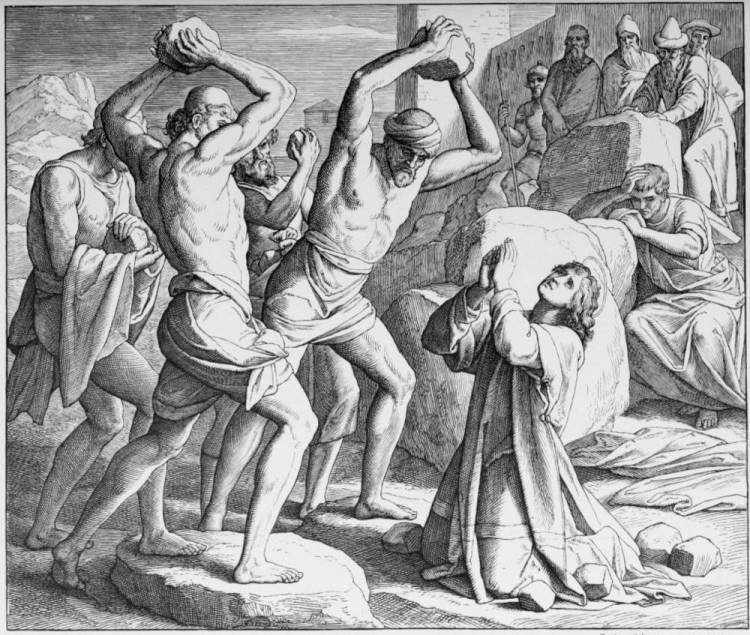
The stoning of Stephen is a tragedy like this. Stephen is a model Christian, highly revered by the early church. He defends the faith with the wisdom of the Spirit; he shows courage and boldness; he faces his critics. He is doing everything right, and still his life is taken from him.
Imagine the devastation Stephen’s friends feel. The hopelessness. Perhaps they were even angry at God for allowing a man of such potential to be taken from them. The early church, still in its infancy, might have seen this as a blow to the advancement of the gospel. But how could they possibly fathom that a witness, someone collecting coats at Stephen’s stoning would pick up the torch to carry the message to the ends of the known world?
When all hope seems lost, God is still at work. Take some time to reflect on your own life, especially the moments of disappointment. Then recount what God taught you, how your faith grew, and how He delivered you. No doubt, some of us are in the midst of a hopeless season. Pray that Stephen’s story would encourage us to trust that God is still working and has a beautiful plan in store.
Lesson 10 – August 9 – Stephen, Unwavering Martyr
More Than Results
“What a waste!” Can you remember a time that you heard or said these words? Perhaps it was about an unwise purchase or some unused food being thrown away.
Sometimes we say things like this about a human life when tragedy strikes. We might be tempted to look at Stephen’s horrific death and say, “What a waste!” He had so much potential. He was selected as a leader in the church in Jerusalem. He was recognized for his ability to serve others in desperate need. And he was killed before his time by opponents who made up false charges. They should have recognized the source of his wisdom was from God!
Our society is often driven by bottom lines and the question “What have you done for me lately?” But the story of Stephen encourages us to ponder more deeply. If Stephen’s encounter with the Sanhedrin were evaluated for its immediate results, then we would consider it a failure. He preached the sermon of his life, but to what end? No fanfare—not even a single convert. His audience murdered him for bearing witness to the truth. If results were the only criterion, then “failure” could be the only reasonable judgment.
But in God’s eyes, Stephen’s life and testimony are not a waste. God values virtue, not only results. God sees our character, even when we fail to achieve the results that we expected. Stephen’s witness has value apart from whatever consequences came. Sometimes people full of faith, grace, and the Holy Spirit are still overcome by their enemies. “You shall receive power”—Jesus’ promise in Acts 1:8—does not mean, “You will always win.” The gospel does not depend only on the results we achieve.
Dear God, You see the big picture when we are limited to what’s right in front of our eyes. Help us to trust that You’re still working, even in those painful and seemingly hopeless times. We pray especially for those among us who are struggling through seasons of loss, uncertainty, or opposition. Grow our faith. Remind us of Your sovereignty and Your love. We pray in Christ’s name. Amen.
Week of July 27 through August 1
Something to think about this week: What do you know about Thomas and faith?
Daily Bible Readings
Mon. – Isaiah 55:6-11 – Seek the Lord.
Tue. – Jude 20-25 – Wait for Christ’s Mercy.
Wed. – John 14:1-7 – Jesus is the Way.
Thu. – Psalm 50:7-15 – Call on the Lord.
Fri. – Deuteronomy 4:27-31 – God is Merciful.
Sat. – John 20:19-23 – Jesus Appears to the Disciples.
Next Week: John 11:14-16; 14:5-8; 20:24-29; 21:1-2
Have you ever been defined by a singular embarrassing moment? Once, as a beginning pianist, I had the opportunity to substitute for the more accomplished pianist in the jazz band. In a moment of horror, I turned the page of my music to find a piano solo I was supposed to improvise, on the spot. I didn’t know how to do that. There I was, with time standing still. Just then, the other pianist came running through the door, pushed me off the piano bench, and finished the song for me. For years I was mocked as a wannabe who could never live up to the other pianist’s skills.

Perhaps no biblical character is as pigeonholed as “Doubting Thomas.” His identity and contribution to Christian history are boiled down to one scene when he refused to believe in Jesus’ resurrection without seeing Him personally.
One of the ugly tendencies of human nature is to reduce people to a single defining characteristic. In truth, people are multifaceted, and reductionism ignores aspects of other’s lives that are beautiful or commendable. Well before Thomas’s infamous moment of doubt, he courageously leads the charge to follow Jesus, even if it means dying with Him. Now that’s a characteristic worth imitating!
You may have been pigeonholed by their past, after a misstep. It may feel hard for you to recover your self-image. Thomas is a reminder that labels do not reflect the totality of who we are in Christ. Thomas was more than a doubter.
Lesson 09 – August 2 – Thomas, Hesitant Believer
The bright lights of the hospital waiting room hummed overhead as Mark scrolled mindlessly through his phone, desperate for any distraction. His father’s cancer diagnosis had shaken him to the core, and well-meaning platitudes like, “God has a plan” or “Just trust the Lord” only made the him simmer. “If God is good, why doesn’t God fix this?” he muttered to a mostly empty room.
It’s not the kind of question that people tend to voice in church. When Mark’s wife invited him to go back to church with her, Mark shot back at her, “You really think I belong with that group?” Lately he had begun calling himself “agnostic about all the questions that matter.” He had no problem with Jesus, only he didn’t see that God made much of an impact in his life. He couldn’t understand why a loving God would allow his hero to face such a struggle.
Actually, it was after his dad died that Mark felt an inclination to go back to church. He had to admit, there was something special about all his those church friends who showed up to honor his dad. They kept saying how much his father had been praying for him, how often his father would ask others to do the same.
“I’m still a skeptic, and that’s not going to change,” he told his wife in the car. “I don’t plan to fake it.”
She nodded but said, “Honey, I think Jesus can handle it.”
Click to expand – What are some of the hardest questions that you have had to bring to God?
There is no shame in having questions. In fact, they help us grow in our faith and become more like Christ. Even as we increase in understanding and wisdom, no one has a complete grasp of God or Scripture. There is always more to learn. Sometimes having one question answered is just a prelude to finding two more.Click to expand – How do you think that Jesus reacts to our honest questions?
Jesus shows us about God and increases our faith. He never seems to lose patience with questions (even those that are rude or meant to trap Him). Just consider all the times Jesus is asked questions throughout Scripture! But Jesus often answers questions in an unconventional way, for He cares more about people and the emergent faith behind the questions.Heavenly Father, We praise You because You see the big picture when we are limited to what’s right in front of our eyes. Help us to trust that You’re still working, even in those difficult times. We pray especially for those among us who are struggling through seasons of loss and uncertainty right now. Grow our faith. Remind us of Your sovereignty and Your love. in Jesus’ name, we offer this prayer. Amen.
Week of July 20 through July 25
Something to think about this week: How did your relationship with your parents change as you grew?
Daily Bible Readings
Mon. – Genesis 3:14-20 – Consequences for Sin.
Tue. – Mark 3:31-35; Luke 11:27-28 – Spiritual Family.
Wed. – Psalm 119:97-104 – Meditating on God’s Law.
Thu. – Luke 1:26-38 – Mary: the Lord’s Servant.
Fri. – Luke 2:15-19 – Keepsakes and Treasures.
Sat. – Isaiah 9:3-7 – To Us a Child is Born.
Next Week: Luke 2:15-19; John 2:1-5; 19:25-27

Lesson 08 – July 26 – Mary, Loyal Mother
He needed me for everything, sleepy as he was. I remember nestling my newborn’s head in my palm with his back against my forearm, and his feet curled up inside my elbow. With his whole life before him, I couldn’t wait to discover his personality and preferences. I could only imagine the skills he’d develop and the character he’d grow to have. Those days, care meant feeding, changing, bathing, and lots of cuddling.
Then came nonsense words, lines of toy cars, and incessant bouncing. He still needed me to brush his teeth, make his meals, and keep him from running into the street. But he sure didn’t fit between my palm and elbow anymore!
“Hey, Mom, you know my orange house?” he’d ask during the imaginative preschool years. His inner world was a delight to discover, as he learned new words to help us communicate. He suddenly wanted step-by-step directions to “do it me-self!”
Today, he’s in high school and dreams of becoming a dentist. He is independent and strong. He waltzes in the door after long days at school, talking a mile a minute. His homework daunts me, his character delights me, and his enthusiasm for life keeps me motivated. These days, the script is flipped, and I think he teaches me more than I teach him—but I’m still available for all the moments when he needs a gentle reminder. And these arms are always eager to offer hugs.
Family of Faith
In our own walk of faith, we will face some of the same kinds of interactions with God as Mary faced. None of us will be asked to be a parent to Jesus, but we will face moments of profound calling and treasured contemplation, or joy and blessing beyond wildest expectations. We will also have moments when our mundane needs go unmet, and we plead with our beloved Lord. And—true enough—we face moments at the foot of the cross, when questions of “Why” and “How” sear our souls and when grief feels overwhelming. We might feel like we are losing all that we hold dear.
Yet God will always be with us; Mary experienced this truth too. She treasured God’s words and the promises she received. She endured to see the glory of resurrection. Mary’s insight and understanding of Jesus also grew over time. The longer that she was with Jesus, the better she was able to understand what God was doing through Him.
Perhaps you have experienced something like this. You might start out thinking that God’s solution to a problem is so obvious, only to find yourself waiting and wondering. Over time, we can find a new understanding of the depths of God’s love. You might find yourself relating to different parts of Mary’s story:
—>Joyful at words of salvation and a message from God
—>Curious about ways that God configures the details of your life
—>Expectant for God to act to do great and miraculous things
—>Grief-stricken by injustice or pain and struggling to comprehend what God is doing
Like Mary, we should be prepared to be with Jesus through all of these times. Mary welcomed the invitation to be God’s servant before she knew all that would be required. She would tell us to make the same choice.
Dear God, Thank You for Mary’s example of faith and trust, even in the most uncertain moments of her life. When we face trying times in our own lives, help us to believe You will see us through. Grow our faith in You so that we can respond with hope and confidence in Your provision. May You be honored in every situation we face. In Jesus’ name we pray. Amen.
Week of July 13 through July 18
Something to think about this week: Redemption and the the story of Zacchaeus
Daily Bible Readings
Mon. – Exodus 22:1-6 – God Calls for Restitution.
Tue. – Isaiah 58:3-7 – Let the Oppressed Go Free.
Wed. Luke 6:20-26 – Blessings and Woes.
Thu. – Hebrews 13:1-6 – Love, Hospitality, and Contentment.
Fri. – 1 john 3:14-18 – Put Love Into Action.
Sat. – Psalm 37:1-5, 18-22 – Commit Your Way to God.
Next Week: Luke 19:1-10

Lesson 07 – July 19 – Zacchaeus, Repentant Tax Collector
Seeking the Lost
Last week we discussed the restoration of Simon Peter as a leader of the early church. You might think to yourself that, of course, Jesus was going to find a way to restore one of His closest friends, an insider and a disciple who had stumbled. Today’s lesson about Zacchaeus is on an entirely different level. Zacchaeus’s starting point is as an outsider to Jesus’ movement. He and people like him are the direct targets of criticism for being too bound up in the ways of the world—where might makes right and taking from the weak is normal.
But appearances can be deceiving. Sometimes we impose rigid formulas when we look at people like Zaccheus or the thief on the cross (whose entry into paradise depended on a simple plea and confession of faith). We might have a rigid understanding of how people need to meet God to have their salvation approved. We like to hear specific phrases, or we want them to have an experience that mirrors our own. Luke doesn’t even share with readers the conversation that Jesus must have had with Zacchaeus over a meal. We only get the result, and we see that Jesus was pleased.
Jesus came to lead lost people back to repentance and salvation. And the change that came over Zacchaeus was profound and life-altering. Instead of tracking people down to extract payment, he would be tracking people down to make restitution. The same skills of calculating interest that he had learned from his trade he could apply to himself—his was the largest of debts. Zacchaeus’s change shows us the remarkable insight of Jesus, who knew that a curious man in a tree was ready to hear the message of the kingdom. As we turn and look around (and up into the trees), may we also find that “the harvest is plentiful” (Luke 10:2).
How can we remember to trust Jesus for salvation?
There is nothing that removes us so far from God that Jesus could never find us. Jesus saw Zacchaeus’s readiness to hear about the kingdom, and Jesus has that same insight into us. We don’t find ourselves or save ourselves. Jesus does that.
Where do you have to look to find the plentiful harvest of people curious about Jesus?
There are people all around us who are curious about faith. When we live so as to reflect the love of God, people will take notice. The effect may not be immediate, but our actions and words will leave a lasting impression. Could your kindness to the grocery store cashier be the first step in a chain that leads them to Jesus?
Father in heaven,
We are humbled and amazed by Your ability to see salvation potential in the most notorious of sinners, like us. At some point in our lives, You met us in our brokenness and gave us the gift of forgiveness and eternal life. Teach us to view other people as having the same potential. Help us to believe that no one is beyond the reach of Your saving arm. In the saving name of Christ we pray. Amen.
Week of July 6 through July 11
Something to think about this week: Where have you been challenged to forgive in the recent past?
Mon. – Acts 2:14-21 – Peter: Bold Gospel Preacher.
Tue. – Psalm 34:1-9 – I Sought the Lord.
Wed. – Psalm 34:10-22 – The Lord Delivers.
Thu. – Mark 8:27-33 – Peter Misunderstands.
Fri. – Isaiah 41:8-13 – God Will Strengthen and Help.
Sat. – Mark 14:55-72 – Peter Denies Jesus.
Next Week: Mark 8:27-29; Luke 22:31-34; John 18:25-27; 21:15-17
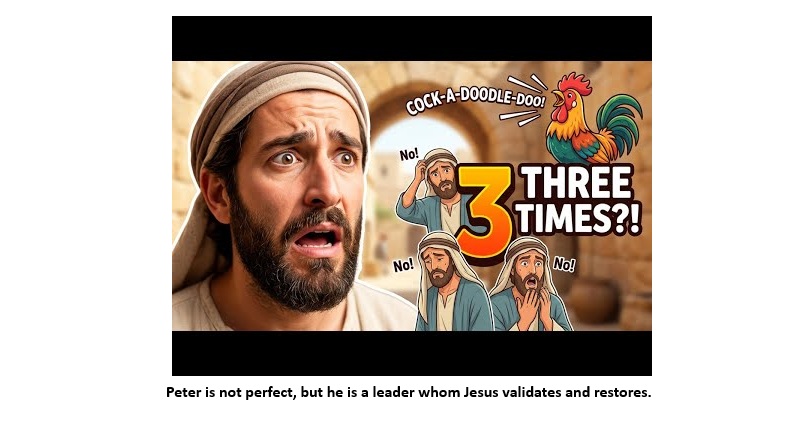
Lesson 06 – July 12 – Simon Peter, Restored Disciple
Some nicknames are meant to encourage; other nicknames are meant to embarrass. My college friend had an awful nickname, and she loathed it. As her closest friend, I never dreamed of calling her by that name.
Together, we were gainfully employed at a movie theater and had a manager that everyone wanted to impress. One fateful night, another coworker dared me to use my friend’s nickname. I dismissed the idea as a joke, but later as I watched her receiving attention from the “super-cool” manager, I felt a wave of jealousy come over me. In front of everyone, I called out to my friend with a name that made her ashamed. I will never forget the look on her face.
The betrayal was unspeakable and petty, and my instantaneous remorse meant nothing. It tortured me that I had been sucked into a silly game, and I might have ended a friendship. It was weeks before I had the chance to apologize, to give what little explanation I could. And I was honest, saying that I had been insecure and jealous. It took time to move past the incident, but we stayed friends.
Even many years later, the story makes me uncomfortable to tell. I am blessed to have a friend who was willing to forgive. And I am grateful that a moment of terrible judgment did not destroy our bond.
When you have wronged a friend or a close acquaintance, sometimes we fear that a mere apology might not be enough. Sometimes we feel the need to make up for our actions in some way. While this instinct is sound, the goal is not to be constantly reminded of our guilt; the goal is to restore a relationship to good standing.
Whether we realize it or not, our own capacity to forgive is tied to our awareness of our own forgiveness. In Matthew 18:21-35, Jesus tells a parable about a servant who acts as a hypocrite and fails to give forgiveness after being forgiven himself. If we struggle to accept God’s forgiveness, it may come to impact our behavior and the expectations that we place upon others. And if we struggle to forgive, we risk looking like the hypocrite ourselves.
Accept God’s amazing grace, and let it transform you.
For all those moments when we wonder whether our past invalidates our future potential, we have the testimony of Peter to encourage us. As we use this week to contemplate God’s forgiveness, let us go forth in gratitude for what God can use imperfect people to accomplish.
Father,
We identify with Peter’s shame and regret for denying You in Your darkest hour. Like Peter, we have had moments or seasons when we have turned our backs on You. Thank You for the incredible gift of forgiveness and reinstatement into Your kingdom work. Use us for whatever purposes You have in store for us. In Jesus’ name we pray. Amen.
Week of June 29 through July 4
Something to think about this week: God’s fairness toward all people.
Daily Bible Readings
Mon. – Isaiah 49:1-6 – A Light to the Nations.
Tue. – Psalm 72:1-13 – A Deliverer Will Come.
Wed. – Ephesians 2:1-10 – Saved by Grace.
Thu. – Ephesians 2:11-22 – No Longer Strangers.
Fri. – Isaiah 60:1-7 – Nations Come to God’s Light.
Sat. – Isaiah 60:8-14 – Nations Bow to Zion.
Next Week: Matthew 8:5-13
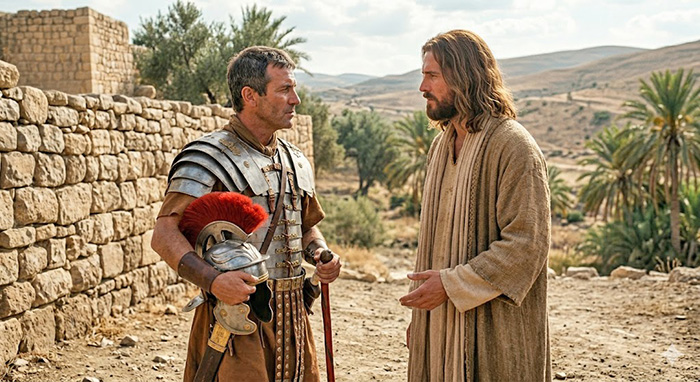
Lesson 05 – July 5 – The Believing Centurion
-A centurion commander comes to Jesus with a request for Him to heal a servant, bedridden at home.
-Jesus seems willing to come, but the centurion suggests that a home-visit is unnecessary.
-He respects Jesus’ authority, and He thinks Jesus might just as well heal at a distance.
-Jesus is pleasantly surprised at the faith that is displayed by this Gentile soldier.
-Jesus deems this greater faith than He has seen among fellow Jews.
-Jesus describes the coming day when all God’s people, Jews and Gentiles, shall be gathered for a feast.
-Jesus dismisses the centurion, and his servant is instantly healed.
“What am I going to do?” Nick asked himself, sweat forming on his brow. He had asked all the college classmates around him for help, but not even the professor had a spare writing utensil. Any other day, he would have been prepared. But he was working late to study for the day’s test and had slipped out the door with everything except a pen or pencil.
The professor gave a five-minute break before the timed exam would begin, and most people would have tried sprinting. Nick knew that he would never be back in time.
As a man of faith, he chose to step outside the building to pray and to clear his head. He asked God to provide, or at least to give him grace with his teacher. While his head was still down, he opened his eyes and noticed something reflective in the grass right in front of him.
If you guessed that a pen appeared before his eyes, you would be correct. Nick loves to tell this story too, a testament to the power of faithful prayer. If he is asked whether he thinks God placed the pen in his path, he will say that he can’t be sure that it just “appeared.” He does know that, had he not stopped to pray, he would not have noticed the pen. It became his own tiny example of what it means to trust in the Lord the power of FAITH!
Faith and trust are two translations of the same word in Scripture. Faith means to be devoted to a person or to a cause. Faith in God means that we have utter confidence in God’s good character and promises. Faith makes us loyal to God and eager to see what God is doing. Faith in Jesus means that we want Jesus to be our Lord.
Click to expand – What Really Amazes Jesus
Think for a moment about all the ways we might try to puff up our chests to distinguish ourselves. Maybe we try to amaze others by our gifts, status, or abilities. Or, from a Christian perspective, we might find ourselves impressed by great learning, spiritual development, or success in ministry. But the centurion’s example demonstrates that Jesus is looking for faith. Ask yourself, do we try to present ourselves as worthy of God’s favor and attention for other reasons? The message is especially encouraging for anyone who feels like an outsider. Perhaps you did not grow up reading Scripture or attending church. Or perhaps you have a past that you try not to bring up in the company of Christian friends. None of that disqualified the centurion. He lacked the right background, education, or religious experience to seem worthy of approaching Jesus. Yet his colorful past and inopportune career made his faith all the more impressive. It should encourage our own search for faith in unlikely places and from unexpected people. To most of Jesus’ followers, a centurion was a person who needed correction. From a strictly logical perspective, anyone involved in the repressive Roman army needed to be put in their place, not affirmed. But Jesus demonstrates God’s willingness to shower unworthy people with grace and attention. In our context, instead of demanding signs and expecting God to work in a visible way, we can look for God’s attention at the margins. If we lack the outward signs of “success,” we can still show faith through quiet obedience to Jesus’ authority. What God is doing is what matters.Lord Jesus, Thank You for the example of the centurion’s faith. As we bring our own needs before You this week, we ask that You would grow our faith. We want to trust You with the deepest hurts and needs, ready for You to answer in Your way and in Your perfect timing. Give us great faith as we pray for Your kingdom to come quickly. In the healing name of Jesus we pray. Amen.
Week of June 22 through June 27
Something to think about this week: The equipping and empowering that God gives.
Daily Bible Readings
Mon. – Isaiah 61:4-9 – Prophecy: Toward Restoration.
Tue. – Luke 15:1-7 – A Shepherd Rejoices.
Wed. – Amos 5:16-20 – Prophecy: The Day of the Lord.
Thu. – Amos 5:21-27 – Prophecy: Let Justice Roll.
Fri. – John 10:1-9 – Know the Shepherd’s Voice.
Sat. – John 10:10-18 – The Good Shepherd.
Next Week: Amos 1:1; 2:11-12; 3:7-8; 7:10-15

Lesson 04 June 28 – Amos, Courageous Prophet
There are many stories in Scripture where God has empowered people to do things they didn’t think they could do. In today’s lesson, we see Amos, who God used in a big way as a prophet. Amos didn’t dream up the idea. It wasn’t his goal. But God gave him a message and used him for His purposes. He picked Amos to do his work, and Amos followed God’s lead.
Sins of the Jeroboams
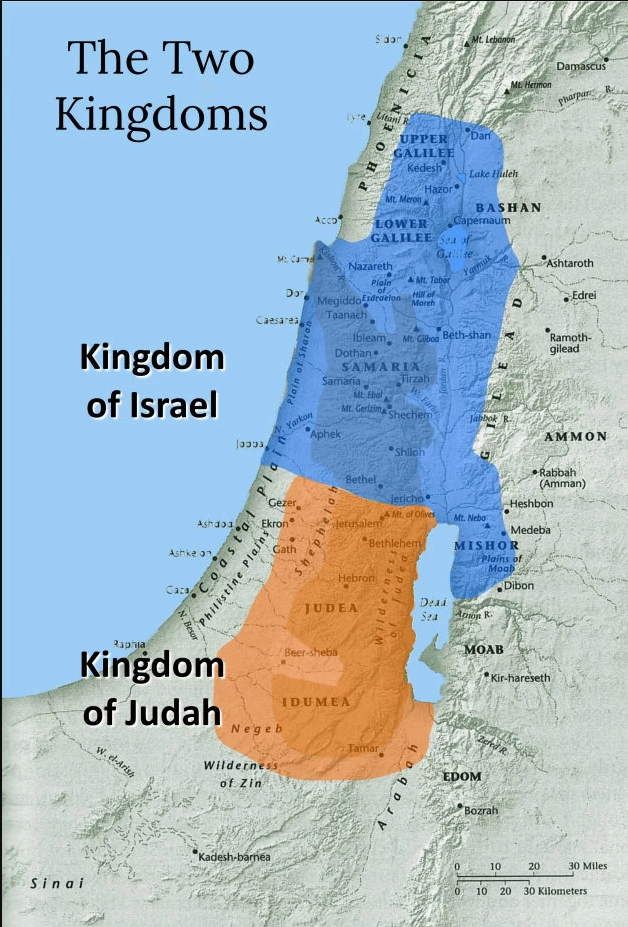
After breaking away from King Solomon’s son, Rehoboam, in the late tenth century BC, Jeroboam I, “son of Nebat,” established a northern kingdom of Israel. He had two golden calves constructed in Bethel and Dan, which is a clear reminder of the idolatrous golden calf in the Exodus narrative.
The Jeroboam who is opposing Amos is Jeroboam II, living about a hundred and fifty years later. Already for several generations, Israel has had its own line of kings, its own priesthood, and its own twisted form of worship. Yet Jeroboam II was king during one of the more prosperous eras. Still, his reign was marked by the same idolatry and wickedness as his earlier namesake: “He did evil in the eyes of the LORD and did not turn away from any of the sins of Jeroboam son of Nebat” (2 Kings 14:24).
-Amos is someone who lives and works outside of Jerusalem, but he received visions from God.
-Even though he comes from Judah, God sends a message about the northern kingdom of Israel.
-Israel has rejected prophets and prevented people from fulfilling priestly vows.
-God is jealously protecting His own reputation by revealing His plans to prophets.
-Amos will go and deliver his warning to Israel.
-Now Amos is in the middle of his prophetic ministry, in the shrine at Bethel.
-He is proclaiming a harsh judgment, upon Israel’s king and priests.
-Like all prophetic messages of judgment, people who hear have an opportunity to repent or to flee.
-But the priest Amaziah tells the king of Amos’s supposed treachery.
-He tells Amos to go back where he came from, back to Judah.
-Amos retells the origin of his prophetic ministry. He does not come from a family of prophets; he was simply called by God to go.
Called to Truth
By all appearances, Amos was a successful shepherd and cultivator of the soil who wasn’t looking to become a prophet. Yet God sent him away from his homeland of Judah to the northern kingdom of Israel with a message of judgment. It isn’t a recipe for outward success. While his warnings went unheeded, they did not go unheard—even the king’s servants could not ignore this Judean shepherd. The king and his priesthood were unwilling to change; they wished Amos would disappear.
One important caveat is that we don’t understand the full impact of Amos’s words for the people who heard them. Long after Amos died, the nation of Judah would also come to understand the exile of Israel as a sign that God does not turn away from sin and injustice. God applies the same standards to all.
Another message is that God empowers the people whom He sends. God continues to call people today. Jesus said, “Whoever believes in me will do the works I have been doing, and they will do even greater things than these” (John 14:12). And Paul agrees that everyone saved by Christ is “created in Christ Jesus to do good works, which God prepared in advance for us to do” (Eph. 2:10).
Every believer is a messenger for truth, no matter the context. It could be through a prophetic or evangelism ministry, but messengers come in all kinds of forms. In Romans 12:4-8 Paul lists spiritual gifts that are distributed among believers. But “sharing the truth in love” is not a spiritual gift: it is a shared responsibility. When we offer ourselves to be “living sacrifices” (Rom. 12:1), we are aligning with God’s will and empowered to do what God sets before us—whether we saw it coming or not.
Gracious Father, You alone are God. You alone are worthy of our worship. We confess that we are susceptible to the lure of idols in our lives. But You alone satisfy our deepest longings. Thank You for Your Word, the Holy Spirit, and the invitation to be honest with ourselves and others. Give us the wisdom to know how to speak openly about Jesus. We pray in Christ’s name. Amen.

Week of June 15 through June 20
Something to think about this week: Your closest friends in each stage of life.
Daily Bible Readings
Mon. – Romans 1:8-12 – A Praying Friend.
Tue. – 1 Corinthians 15:30-34 – Choose Your Friends Wisely.
Wed. – Proverbs 18:19-24 – A Friend Closer than a Brother.
Thu. – Ruth 1:11-18 – Friends Stick Together.
Fri. – John 15:9-17 – Friends Love Radically.
Sat. – 1 Samuel 20:16-17,32-34, 42 – Sworn Friendship.
Next Week: 1 Samuel 18:1-4; 20:16-17,32-34,42; 2 Samuel 1:26-27; 21:7

Those who serve in the military can attest to the depth of love that each person shows for one another. This recalls Jesus’ words, “Greater love has no one than this: to lay down one’s life for one’s friends” (John 15:13). Paul notes, “Very rarely will anyone die for a righteous person, though for a good person someone might possibly dare to die” (Rom. 5:7).
Jesus took things one infinitely big step further. Jesus submitted to God’s plan and in doing so, secured freedom from sin and its consequences for all who believe in him (Gal. 5:1). Jesus says this about His friends: “You did not choose me, but I chose you and appointed you so that you might go and bear fruit” (John 15:16).
Lesson 03 – June 21 – Jonathan and David, Resolute Friends
Jonathan is the oldest son of Saul, the first king of Israel. But because of Saul’s disobedience, God has already decided that Jonathan will not follow his father as king (1 Sam. 15:26-28). Instead, God sends Samuel to anoint an unexpected person of God’s own choosing—the young shepherd named David (1 Sam. 13:14; 16:1-13). The reading begins as David has just slain the giant, Goliath (see 1 Sam. 17). Jonathan is probably older than David, but he treats him as an equal.
-Jonathan is not jealous of David’s growing popularity.
-Whereas Saul is trying to control David, Jonathan makes an alliance with him.
-Jonathan gives David gifts that treat him like a prince.
-The crown prince, Jonathan, stands up to his father on behalf of David.
-Saul even throws as spear at his son, whom he thinks is acting foolish.
-Jonathan and David part in friendship, vowing to be loyal to the families of each other forever.
-Later Jonathan is killed in battle, alongside his father.
-David memorializes these men in song and poetry and praises his fallen friend.
-When David is king, he shows kindness to Jonathan’s son, Mephibosheth.
Seeking God’s Interests
Jonathan’s enthusiastic alliance with David is staggering, even as we look at it thousands of years later. As the son of a king, Jonathan could have used his power to keep David in line, even kill him to prevent losing the throne. Instead, Jonathan does not cling to the throne of his father but submits to God’s choice in the matter. Jonathan could not have known that God had a longer-term plan to renew the very meaning of kingship through David’s future descendant, the King of Kings and Lord of Lords (1 Tim. 6:15; Rev. 17:14). From Jonathan’s perspective, David is just God’s choice—inscrutable as it might have seemed.
And yet, Jonathan saw plenty of evidence of God’s favor upon David. We don’t know whether David shared that he had been anointed by Samuel, but Jonathan witnessed David’s heroic defeat of a giant who had stood against the God of Israel (see 1 Sam. 17). Jonathan—a heroic warrior himself (1 Sam. 14:1-14)—still was not the one whom God chose to go against the Philistine champion. Later, Jonathan’s actions were driven both by genuine love and concern for David, reflecting Jonathan’s support for what God was doing in and through him. Instead of protecting his own interests, Jonathan did what was best for the nation. He stood in the breach between Saul’s troubled rule and David’s eventual kingship.
Submitting to God’s plans can contradict our self-interest or desire for recognition. We dare not expect God to endorse our plans instead of His. Jesus modeled the selfless submission to God’s will when He laid aside His life (Luke 22:42). As we humbly seek God’s will, we are freed from obliging our self-interest, free to choose the path that brings glory to God.
Lord Jesus, Thank You for the friends You have given me. They have been a godly influence in times of difficulty. Thank You, Jesus, for people who urge us to walk in Your ways. Jesus, teach us to be a friend the way that You are a friend to us. We ask in Your name. Amen.
Week of June 8 through June 13
Something to think about this week: Taking our concerns to God in prayer.
Daily Bible Readings
Mon. – Ezekiel 18:5-9 – Living a Righteous Life.
Tue. – Genesis 16:1, 4-16 – Trusting a God Who Sees.
Wed. – Proverbs 6:20-22 – Keeping Wise Counsel.
Thu. – Psalm 113 – Praising the Lord.
Fri. – Isaiah 66:9-13 – Comforting like a Mother.
Sat. – Luke 1:46-55 – Rejoicing in God’s Deliverance.
Next Week: 1 Samuel 1:9-20,25

Lesson 02 – June 14 – Hannah, Faithful Supplicant
Rekindled Hope
Many of us experience times of powerlessness, when heartfelt prayers are all we have. Hannah’s prayers and vow are met with a blessing. Hannah never actually explains the nature of her request before God (to Eli), but words of blessing are important—particularly when spoken by Israel’s spiritual leader. Eli anticipates God’s action: “may the God of Israel grant you what you have asked” (v. 17).
The writer of the biblical text seems to enjoy the irony: Eli blesses the coming of a child whom God will choose to replace Eli. In the following chapters, the text describes his terrible leadership and inability to hear from God (see 1 Sam. 3:1,11-14). But here he is just a priest who missed the point and was searching for the right words to say.
Hannah knows that her situation has changed. Her posture is altered, and she feels able to eat and to carry on with her family once more (v. 18). Through Eli’s words, she recalls God’s gracious character.
To make the long journey home, the family rises early. Later when they are home, God allows Hannah to conceive (v. 19). This phrasing—God’s remembrance of a childless woman—is also used when Rachel first conceives (Gen. 30:22). Like other miraculous births in Scripture, the child is special, his role carefully prepared.
Hannah’s anguish will follow her no longer—she gives birth to a son! Names in Scripture often give clues about a person’s role. Hannah, the boy’s long-suffering mother, chooses a name to remind everyone of his origin: she asked for a son, and God granted her prayer. Thus the name “Samuel” sounds like the Hebrew verb for “ask” combined with a title for God. Samuel’s name is a reminder of answered prayers and petitions.
Many parents would not dream of giving up a precious child, but Hannah is faithful to the letter of her vow, returning him for the Lord’s service. Once he is no longer nursing, she brings him back to Eli (1 Sam. 2:25). Hannah’s desire for a son wasn’t just for her own sake, and God used her desires and prayers to bring leadership to His people—to bring them back to covenant faithfulness. This son of Hannah’s would go on to be a prophet, priest, and judge. He would go on to anoint two of Israel’s kings.
God’s blessing upon Hannah also went beyond her request for one child. Although she would visit Samuel each year, she would also have five more children (1 Sam. 2:19-21). God turned Hannah’s anguish into great joy.
Click to expand – How was God’s answer to Hannah’s prayer even better than a simple yes?
If God had given a son of no special significance, Hannah would’ve had a child to love. But God goes beyond her request for a son, giving someone who will restore leadership to Israel.Click to expand – What are some of the good gifts that God enjoys giving?
God seems to enjoy lavishing forgiveness, the Holy Spirit, and life itself. He makes the rain fall on all people, whether just or unjust (Matt. 5:45). Jesus says that part of the Father’s character is the enjoyment of giving (Matt 7:9-11). For the same reason that we are given good things, we should be eager to be generous toward others.Click to expand – Why might God say no to some of our prayers?
God’s understanding is greater than our own, and He has plans for us that go far beyond what we imagine. Until we meet God face to face, we might only glimpse bits and pieces of what He is doing and why some prayers are answered differently than others. Still, the Lord invites us to find our comfort and joy in Him. His Spirit can fill us with joy, no matter the circumstances.Gracious God, You are the giver of every good and perfect gift. Thank You for your incredible faithfulness in the past (what we see in the pages of Scripture) and in our lives. As we face future periods of longing, grow our patience and faith. Be near to us; and help us to trust You to provide, according to Your will and Your timing. We pray in Jesus’ name. Amen.
Week of June 1 through June 6
Something to think about this week: Faithful witnesses in Scripture
Daily Bible Readings
Mon. – 1 Timothy 3:1-7 – A Leadership Example.
Tue. – Acts 9:36-42 – A Leader Who Cares.
Wed. – Acts 18:24-28 – A Leader Who Teaches.
Thu. – Nehemiah 2:1-8 – A Leader Who Listens.
Fri. – Nehemiah 4:1-6 – A Leader Who Intercedes.
Sat. – John 13:3-17 – A Leader Who Serves.
Next Week: Judges 4:4-10,14, 21-22

Deborah is called a prophet in Judges 4; and she is acting as a judge of Israel, listening to disputes and handing out decisions. She is the only female judge mentioned in the book. But Deborah is not the only female prophet in the Bible. Miriam, Moses’ sister, is called a prophet in Exodus 15:2o; and 2 Kings 22:14 recognizes Huldah as God’s prophetic messenger to Josiah. In the New Testament, Anna speaks about the baby Jesus to everyone (Luke 2:36-38). Philip’s daughters in Acts 21:9 are also called prophets. God’s Spirit is poured out on both men and women who prophesy, declaring the messages of God and sharing the good news about Jesus (Joel 2:28-29; Acts 2:14-18).
Lesson 01 – June 7 – Deborah, Dutiful Judge
Clues Point Back to God
The biblical text tells us that Deborah is a prophet. We readers are waiting to see her words proved true, since this is the mark of valid prophecy (see Deut. 18:21-22). But imagine the suspense from her perspective, which we only see in bits and pieces! Deborah was courageous enough to call God’s people to the defense of their territory against the superior foe. And when the confidence of Barak wavered, Deborah’s word remained the same.
She was willing to risk her safety to accompany the army, and she gave the word for the attack. Before that day, no one would have predicted strong chariots becoming useless, or that the arrogant Canaanite commander would die by tent peg. Perhaps you have played a murder mystery game where you have tried to guess the circumstances of a person’s death. Would anyone following the clues guess, “The woman Jael, in a tent, with a tent peg”?
But God uses the unlikely and improbable circumstances to drive the message: victory belongs to Him. Without relying on God’s miraculous intervention, the scattered tribes of Israelites would never control or manage the important land they were possessing. It calls to mind the words of Moses to his successors: “The LORD himself goes before you and will be with you; . . . Do not be afraid; do not be discouraged” (Deut. 31:8).
Sometimes we need the unexpected to wake us up to our inability to save ourselves. If Barak had summarily marched the army to a conventional victory, there would be songs written in his honor. Instead, the song of Deborah and Barak praises God and the people who answered His call (Judg. 5:1-31). The conclusion of God’s mighty work is this: “The land had peace forty years” (v. 31).
Click to expand – What feels different about resolving a problem with God’s help instead of on your own?
When we solve problems with God’s help, we become aware of how much we rely upon Him. We can trust that God knows our troubles and has a plan for the future. Solving problems on our own can leave us anxious and unsettled, just waiting for the next thing to go wrong.Click to expand – Where and when are you tempted to credit your own ingenuity or work ethic for success?
It can be easy to list our accolades, accomplishments, and skills as a way of saying to ourselves, I did this on my own. When we take the credit, we miss the greater context: God is the one who provided all the skills we have in the first place.Click to expand – Where do you recognize the faith and courage of others who are following God into risky situations?
We can be encouraged by the example of other people who live courageous lives of faith. We might think immediately of people who are involved in missionary work in parts of the world that are hostile to Christianity. Or, we might have friends and family who set their own interests aside to help others (displaying confidence in God’s provision).God’s Surprising Plan of Salvation
Throughout Scripture, God’s rescue plans often look different from what the world would expect. A group of slaves overcome Pharaoh and the most powerful nation in the world. These former slaves and wanderers form a strong nation in the land that God gives to them. The youngest son of Jesse, David, is chosen over his brothers, becoming the greatest king of Israel.
It may seem upside down to us, but the kingdom of God reorients how we look at power. The way of God brings salvation to the whole world by surprising us, again. The world in need of rescue is saved by God’s incarnate Son without a display of visible power but by dying on the cross. Jesus is born through unusual circumstances (a virgin’s conception). He does not appear like a conquering king with trappings of authority. Instead, He grows up in Galilee and lives a simple life. His rescue involves sacrifice and suffering giving Himself. As the greatest surprise, Jesus secures victory over death and sin for anyone who turns to Him.
Father, We praise You for Your ability to achieve Your plans, even when we’re fearful. We want to grow in our faith, allowing our confidence in You to overcome our fears. As we walk with You, teach us how to be trusting and courageous, wherever You may lead us. In Jesus’ name we pray. Amen.
Week of May 25 through May 30
Something to think about this week: Has God been inviting you to something new?
Daily Bible Readings
Mon. – Psalm 95 – Let Us Sing to the Lord.
Tue. – Psalm 122 – Gladness in the House of the Lord.
Wed. – Romans 12:1-8 – Members of the Body of Christ.
Thu. – Nehemiah 8:9-12 – A Holy Day of Rejoicing.
Fri. – Matthew 18:15-20 – Restoring Healthy Relationships.
Sat. – Acts 4:32-37 – Fellowship Through Common Property.
Next Week: Matthew 28:18-20; Hebrews 10:22-25

Help Each Other Be Strong
24 We should think about each other to see how we can encourage each other to show love and do good works. 25 We must not quit meeting together, as some are doing. No, we need to keep on encouraging each other. This becomes more and more important as you see the Day getting closer.
Lesson 13 – May 31 – Living in Christian Community
When I was eleven, my family went on a home-building missions trip. On the drive, I daydreamed about what the build might be like. I saw myself at sunset, wiping sweat from my brow, nailing together two pieces of recovered driftwood, flimsy pieces of cloth fluttering in crudely constructed windows.
Imagine my surprise when we arrived on the build site to see a concrete foundation, industrial-grade paint, and precut lumber. I’d pictured myself an eleven-year-old construction prodigy and found myself entrusted with naught but painting the grooves of the exterior-facing plywood. I was a child, so my sense of defeat lasted only until an adult placed a paintbrush in my hand. Then I was off, working vigorously alongside the other children; suddenly it was lunch time and the walls were done. Then there was the trim to paint, the scrap wood to collect, and the waters to hand out. A day-and-a-half later, the whole house was complete walls, trusses, window bars, shingles, awning and all.
As we presented the house to the family, I remember looking up at it, so much bigger and grander than the one I’d imagined. I’d thought God had brought me out there to change the world with my wits and the spare wood I could find; but I realized He’d sent all of us, the whole team, to show this family that He loved them. Without everyone working together, we’d never have been able to complete such a project. God’s plans were so much greater than mine.
Click to expand – Have you ever been part of a team that worked well together?
When people work together in a group, the experience can range anywhere from really good to really bad. After all, even people who are like-minded will disagree at points. But when a group communicates through differences and works together toward a common goal, they accomplish far more than each member could do alone.Click to expand – Why do you think Scripture emphasizes encouraging others?
Scripture is full of examples of Christians and churches working together to spread the gospel in a far-reaching manner. Our reach goes beyond what a single person could do. When Christians meet together, they build one another up and deepen their commitment to walking with God through everyday moments.Matthew 28:18-20 Easy-to-Read Version
18 So he came to them and said, “All authority in heaven and on earth is given to me. 19 So go and make followers of all people in the world. Baptize them in the name of the Father and the Son and the Holy Spirit. 20 Teach them to obey everything that I have told you to do. You can be sure that I will be with you always. I will continue with you until the end of time.”

Jesus,
You called us to make disciples of all nations, and that can feel like a daunting task. Give us a vision for the way you have uniquely gifted us to be effective for Your kingdom. As we gather in worship and Bible study, help us to encourage one another as we partner together to make disciples of all nations. Amen.
Week of May 18 through May 23
Something to think about this week: The freedom we enjoy as Christ’s servants
Daily Bible Readings
Mon. – John 2:1-11 – A Feast of Finest Wine.
Tue. – Genesis 21:1-8 – Celebrate God’s Blessings.
Wed. – Zechariah 8:1-5 – Playing Children Signal God’s Grace.
Thu. – Colossians 2:16-23 – Release from Human Rules.
Fri. – Matthew 11:7-11, 16-19 – A Time for Feasting and Joy.
Sat. – Jeremiah 31:10-14 – Rejoice and Be Glad.
Next Week: Mark 2:18-28

The Sabbath is a gift from God, designed not as a burden but a delight. Once a week we are invited to rest and enjoy the Creator and His creation. If a Sabbath is already part of your rhythm, write down how you hope to spend it. If Sabbath is not your routine, plan a Sabbath with the Lord of Sabbath.
Lesson 12 – May 24 – Christian Rhythms of Life
Jesus at the Center
Fasting and Sabbath observance are practices that can seem strange and foreign to the modern world. But notice that many people are obsessed with productivity, self-care, time-management, and dieting. We track steps, schedule rest, and follow rules about what we should and should not do with our bodies and our time. While we don’t face the same religious pressures, many of us can relate to the burden of constantly trying to “do it right.” Whether it’s how we eat, rest, or work, the pressure to live by human-imposed rules can feel relentless.
This is what makes Jesus’ teaching in Mark 2:18-28 so striking. He does not dismiss fasting or observing the Sabbath as outdated or irrelevant. Rather, He redefines these practices, centering them on Himself. When questioned about fasting, Jesus reminds the people that His presence invites joyous celebration. The time for fasting and mourning comes when He is absent. When His disciples are criticized for not following Sabbath traditions, Jesus responds by saying that the Sabbath is for people, not vice versa. As Lord of the Sabbath, He has authority to interpret a God-honoring Sabbath routine.
It is easy for people to focus on outward appearances, but Scripture shows that God observes the heart (see 1 Sam. 16:7). Fasting, which is useful in times of intense prayer, expresses dependence on God. Likewise, Sabbath serves as a reminder that God is our provider, giving rest to the weary.
Fasting and Sabbath are not ends in themselves, but they should point us to Jesus. He fulfills our deepest hunger and gives us true rest. He should be at the center of our fasting, prayer, rest, and work. When our lives revolve around Jesus, these practices become life-giving instead of burdensome. Only through Him can we find true rest and fulfillment.
Click to expand – In what ways can people miss the point of fasting and observing the Sabbath today?
One of the easiest ways to miss the point of fasting and Sabbath is to turn them into a rigid system of rules that must be followed. When people focus on outward actions and performance (especially to impress others), they stray from God’s intent. He wants these practices to be a means for people to connect with Him in relationship.Click to expand – How might knowing that the Sabbath was made for people challenge your view of rest?
While it can be tempting to see the Sabbath as a burden, it should be regarded as a gift. God has given it to people for their own good. No one needs to feel guilty for enjoying rest, nor should they feel bad for doing necessary things that help others on the Sabbath.Click to expand – What are some practical ways we can keep Jesus as the center of our lives?
Spending regular time in prayer and Scripture is perhaps the best way to keep Jesus at the center. Fasting is a way we can express dependence on Him, and Sabbath rest can be a wonderful time to enjoy His presence. We can closely examine our daily habits to find ways to include Jesus in our lives.God,
Thank You for building a day of rest into Your plan for us. In a society that values busyness and productivity, help us to embrace the counter-cultural rhythms of rest and reflection. For those of us who are always on the go, show us how to find the time for Sabbath within our busy schedules. Amen.
Week of May 11 through May 16
Something to think about this week: Economic justice that God wants us to seek in our working lives.
Daily Bible Readings
Mon. – Proverbs 10:1-5,15-16 – Work Diligently Before God.
Tue. – Matthew 20:1-16 – The Workers and Their Wages.
Wed. – Amos 5:6-15 – God Demands Justice for All.
Thu. – James 5:1-11 – Wait Patiently for God’s Justice.
Fri. – Colossians 3:12-17 – Serving with Enthusiasm.
Sat. – Deuteronomy 24:14-21 – Justice for the Worker.
Next Week: Deut. 24:14-21; Eph. 6:5-9; 1 Tim. 6:17-19
Lesson 11 – May 17 – Christian Manner of Justice
Work is important and necessary to provide for ourselves and our families. But God’s followers are to trust in His provision and to live out of that trust, acting justly in all matters. Both Moses (in Deuteronomy) and Paul (in Ephesians and 1 Timothy) emphasize that the powerful and the powerless—who must live and work together—are to respect one another by sharing in the abundance of God’s provision. The benefits of godly justice are meant for everyone, regardless of ability or social standing.
In his parting words to Israel, Moses gives instruction for life in the promised land. God redeemed Israel from slavery in Egypt; He requires their just and generous treatment of the poor and powerless among them: hired workers, foreigners, orphans, and widows.
Holding Wealth Loosely
We talk about how to handle our money when it often feels more like our money handles us. No matter how much or little we have, it never feels like enough to satisfy our desires or allay our fears. And we can’t shake the reality that money correlates with power, and that those who have less are at the mercy of those who have more.
The Bible offers us a way out of money’s grip: to hold our money with an open hand. We can begin to do this with two changes of mindset.
First, we can abandon a scarcity mindset, the voice in our head that tells us, There’s not enough for everyone—you have to fight to get yours. The Bible paints a different picture. God “richly provides us with everything for our enjoyment” (1 Tim. 6:17). God has not made a world where we must fight for our “piece.” Instead, we share to have peace. There is no certainty or peace in the possession of wealth.
Second, instead of lording our money and power over others (or wishing we could), we can “have the same mindset as Christ Jesus,” who became a servant (Phil. 2:6-7). Servants have no wealth to be concerned about, and they focus on the needs of others. Regardless of our bank accounts or social standing, we have the one Master and one Lord (Matt. 23:10; Col. 4:1; Eph. 4:5).
Approaching our money and possessions with an abundance and servant mindset, we become as free in our sharing as in our receiving. While we work to provide for ourselves and our families, we can also help those around us who are struggling. There’s no shortage of people needing help. We can make our churches places where the poor and the powerless experience God’s abundance through Christlike generosity. And when we hold money with open hands, we rediscover “life that is truly life” (1 Tim. 6:19)-God’s abundance.
Click to expand – How would the world be different if everyone adopted an “abundance mindset”?
The fact that God owns everything should free us to not hold onto our “stuff” so tightly. Without competition for resources, there would be more cooperation and sharing, less fear and greed. This could likely reduce small-scale acts of petty theft, or even large-scale tragedies like war.Click to expand – How easy or difficult is it for you to see yourself as a servant?
Some people are naturally hardwired to serve. Paul even mentions a spiritual gift of “helping” (i Cor. 12:28). Others of us struggle to see ourselves as servants, especially in a context where freedom is one of the highest ideals.Click to expand – We live in an era of long lifespans, retirement planning, and long-term care. What does it look like to balance responsibility (saving) and generosity (sharing)?
There is no easy answer for this. There is no one-size-fits-all solution. We can reason that, our Lord Jesus will probably set different expectations for different people. There are Christians today and throughout history who have given up saving altogether, accepting lives of poverty, in order to devote themselves entirely to service. For many other Christians, investing and strategic saving is the normal pattern. With that lifestyle of saving, Christians can also show radical generosity. When we know our financial needs are met, we might find even more freedom to bless others.Gracious God, Thank You for the work You give us to do each day. Help us to see our work not only as an occupation but as a mission field. Teach us to be openhanded with all we have been given, and show us how we can bless others as You have so abundantly blessed us. Amen.

Week of May 4 through May 9
Something to think about this week: God’s intention for our working lives
Daily Bible Readings
Mon. – Genesis 2:4-10,15 – God Ordains Productive Work.
Tue. – Proverbs 16:1-3, 8-9 – Commit Your Work to the Lord.
Wed. – Psalm 8 – Caring for the Work of God’s Hands.
Thu. – Exodus 31:12-17 – The Sabbath Is a Perpetual Covenant.
Fri. – John 5:8-11, 16-17 – Working on the Sabbath.
Sat. – Acts 20:31-35 – Supporting Oneself and Others.
Next Week: Genesis 2:15; Exodus 20:9; John 5:17; 94 Acts 20:33-35;2 Thessalonians 3:6-12

Lesson 10 – May 10 – Work As A Christian Duty
Do you tend to think of work as an imposition or a blessing?
It’s natural for us to seek leisure and to minimize what we think of as “work.” But from a theological standpoint, there has never been a world without a job for humans to do. While we each might take a different path in our working lives—perhaps longing for retirement, when the fruits of our past work can sustain us—many people find alternative habits of work and service, even when they don’t have need for more income. Our work can be a blessing to us, but it can also bless others.
What are some ways that we overvalue our own work and let it define us?
Who among us has not felt the need to define ourselves by our profession and our work? If we have a good job with important responsibilities, perhaps we feel like an important person too. If we are unemployed or underemployed, it can easily cut us to the core and make us feel powerless. Ultimately, work is not what substantiates our value to God. God does not need anything from us, and we can ask God to help us to keep a healthy open-handedness about the way we earn a living.
Where do we see evidence that the work of God is still continuing to this day?
We might see changes that God has wrought among our friends and neighbors. Or perhaps we think of desperate needs remaining in the world. When we see famines, war, and fractured relationships, we also know that God’s world is not yet remade, not yet fully conformed to the image of Christ. Where we see the gaps, we know God is not distant.
Even Paul, the one who first brought the gospel message to Thessalonica, was someone who worked with his hands. Acts 18:4 tells us Paul’s trade was “tentmaker.” That would mean that he worked with various fabrics and textiles, repairing woven fabrics and leather goods. As a former rabbi, Paul would have learned his trade as his means of supporting himself. Jewish rabbis were expected to pair their knowledge of Torah with a secular occupation.
Traveling Preachers and Teachers
Click to expand – What kind of activity and hard work leaves you with joy?
Maybe you are a caregiver, and you can’t get enough warm snuggles from your kids. Maybe you host guests for a meal, and you love making delicious food. Maybe you are a carpenter by trade, and you feel immense satisfaction when you see all the edges of trim line up as they should. However God wired you, there is something in this world that you are created to do. It doesn’t mean you are competing to be the best.Click to expand – When have you been challenged to find meaningful work?
Those of us who have struggled with underemployment or unemployment know how hard it can be to want to work and not be able to find work. Others find a trade that pays the bills, but they keep wanting something more from their work. Take that request to God.Click to expand – In God’s kingdom, what is the kind of responsibility that you have been given?
God created each of us for a purpose, and sometimes it takes years to discern what ministry role we are meant to play. Some people discover that the “retirement” they planned turns out to keep them very busy serving at church, welcoming the stranger, being someone who can be called upon. We can be confident in the future plans that God has for us.Heavenly Father, Although it can be hard to say, thank You for the privilege of having work to do. We see You at work and are grateful to partner with You as we labor on earth. Give us joy and energy throughout our days, and help us to see Your purposes in our work. Amen.
Week of April 27 through May 2
Something to think about this week: Our hesitations to share the gospel.
Daily Bible Readings
Mon. – Jeremiah 29:3-7 – Seek the Welfare of the City.
Tue. – 1 Peter 2:4-12 – God’s Own People.
Wed. – 1 Timothy 2:1-8 – Pray for Those in Authority.
Thu. – Psalm 33:10-22 – God Is Sovereign over the Nations.
Fri. – Philippians 3:17-21 – Our Citizenship Is in Heaven.
Sat. – Jonah 3:1-5 – A Season of National Repentance.
Next Week: Jonah 3:1-5; 4:6-11

Lesson 09 – May 3 – Christian Expectation of Grace
After Jonah spends three days inside a “huge fish” (Jonah 1:17; 2:10), God once again commands him to do the very thing he had tried so hard to avoid: preach to the people of the city of Nineveh. Jonah knew that the Ninevites had opposed and harmed Israel. Jonah didn’t want repentance and mercy—he wanted judgment and destruction. He traveled as far as he could from “the presence of the LORD” (1:3). But of course, God cannot be escaped (Ps. 139:7-10). God would still use this reluctant prophet.
Click to read a summary to the conclusion of the Jonah story
Even though Jonah ran away from God’s command—God sent the great fish to swallow him and bring him back—Jonah has a second opportunity to heed the call. It could be that Jonah is still sitting on the shore of the Mediterranean Sea, freshly out of the great fish (gross). Or maybe he first returned to Jerusalem to offer sacrifice, as he promised from the belly of the creature (Jonah 2:9). The text doesn’t say. Whatever the case, God comes to Jonah and repeats the command to preach in Nineveh. In essence, God is giving Jonah a “do-over.” His patience and mercy are on display for Jonah, who had disregarded the message the first time. God has not given up on Jonah, and God has not given up on the residents of Nineveh, despite their sin and heinous treatment of subjected people. When God commands, “Go to the great city of Nineveh,” He does not mention the city’s wickedness again (Jonah :; compare 1:2). That was the part that Jonah could wholeheartedly agree upon! God simply instructs Jonah to “go” and to “proclaim” whatever message that God will supply, at the appropriate time. Sufficiently humbled and compliant after three days inside the fish, Jonah gets up and travels to Nineveh. To be clear though, this journey would take weeks on foot, depending on where he begins. Jonah is now willing to heed God’s direction. Nineveh was not yet the capital of an Assyrian Empire, but it is called simply “a very large city” (Jonah 3:3). It is so large that its metropolitan area takes “three days” for Jonah to traverse. After arriving, Jonah journeys to the heart of the city, proclaiming the message that God has given him: “Forty more days and Nineveh will be overthrown” (v. 4). In a modern context, this sounds strange. We are not in the habit of closely listening to the words of traveling prophets, those proclaiming a message of judgment on the street corner. Assyria and Israel were military enemies. The residents and leaders of Nineveh face the curious sight of a lone, courageous prophet in their midst one whose reputation for accuracy might have preceded him (see 2 Kings 14:25). And they listen to the message. Before Jonah makes it through the entire city, his message has its intended effect. As a result of Jonah’s faithful, but reluctant, preaching, “the Ninevites believed God,” signaling their profound repentance with fasting and other signs of mourning, “from the greatest to the least” (Jonah 3:5). From the king on down, the people repent and ask God’s mercy (see vv. 6-9). When God sees their repentance, He responds in the way that God always responds to a repentant heart: He shows mercy (v. 10).Reflecting God’s Mercy
Through the illustration of a plant and its shade—not to mention by bringing Nineveh to repentance in the previous chapter—God showed Jonah that He is merciful and compassionate toward all people. Jonah needed to display that same mercy, but he preferred retributive justice. God calls Christians today to respond to the grace received through Jesus by showing compassion and mercy to others—even for those who are difficult to love.
Jonah’s example should help us to consider the importance of extending God’s grace to anyone we consider undeserving. God knows their hearts, and ours. While it is better to be at peace with those around us, it is not always possible for us to see justice served or our enemies come to ruin. And this text would suggest it shouldn’t please us when we do.
God calls us to extend the same mercy to others as He has shown toward us. God will bless our efforts, whether those blessings are immediate or not. We are to be merciful because God is merciful (Luke 6:36). God knows our hearts, and He has offered forgiveness before we come to all the right conclusions. Therefore, as those who have been forgiven, we are to forgive in return (Luke 7:47).
In His Sermon on the Mount, Jesus says, “Blessed are the merciful, for they will be shown mercy” (Matt. 5:7). His brother James is even more blunt: “Speak and act as those who are going to be judged by the law that gives freedom. . . . Mercy triumphs over judgment” (James 2:12-13). As we obey, God will give us peace in our hearts, and God will judge properly. Whatever anger, grudges, or violations that we cannot surrender—we are only harming ourselves.
Click to expand – How should an awareness of God’s mercy to us help us be merciful to others?
God’s mercy to us should remind us that He desires us to be merciful to everyone—even those we don’t like. As we better appreciate and are humbled by the grace and mercy we have received through Jesus, we should become more willing to extend compassion to others, whether we “naturally” want to do it or not.Click to expand – What does God’s Word reassure us will happen when we are merciful?
The bottom line is, God calls us to be merciful, just as He is merciful (Luke 6:36). As we obey, He will give us peace (Isa. 48:18; John 14:27). We should let God be the final judge—and show mercy however He sees fit.Click to expand – Where do you lack mercy? How would you ask God to address it?
Almost all of us have “cold spots” where we’re bitter, jaded, or unforgiving: the relationship we can’t get over, the sibling who won’t call us back, the person we can’t stand who lives nearby. We should ask God to address those “cold spots,” calling up in our minds the ways that mercy was shown to us. Being humble enough to let God work is often the first step.Grace Available to All
Followers of Jesus are grateful for the gift of grace extended to us, while we were yet sinners. Sometimes it can be hard to want others, especially those who have irritated or wronged us, to have access to that same grace.
Jesus, Thank You that no one is too far gone to be reached by the gospel. You met us in the depths of our own sinfulness and extended Your grace to us, and for that we are eternally grateful. Open our hearts to those in our spheres of influence who don’t yet know You. Reach them with Your truth, and use us if You so desire. Amen.
Week of April 20 through April 25
Something to think about this week: Raising children and honoring family relationships.
Daily Bible Readings
Mon. – Proverbs 24:1-6 – By Wisdom a House Is Built.
Tue. – Luke 2:40-52 – Growing in Divine and Human Favor.
Wed. – Ephesians 5:21-33 – Submit to One Another.
Thu. – Joshua 24:15-21 – Choose Whom You Will Serve.
Fri. – Joshua 24:22-28 – We Will Serve the Lord.
Sat. – Matthew 19:3-9 – An Inseparable Union.
Next Week: Deuteronomy 6:3-9; Matthew 19:3-9

Two Tablets of Exodus 20
When Jesus later summarizes the whole meaning of the Law and Prophets as love of God and love of neighbor (Matt. 22:39-40), some think that He is not only alluding to Leviticus 19:18 but also to a way of reading the Ten Commandments (Ex. 20:1-17; Deut. 5:6-21). If the commandments are equally divided into two halves—Exodus 34:1 mentions “two stone tablets”—the first half tells how to worship God (no other gods, no idols, no misuse of God’s name, remember the Sabbath). That is the vertical dimension to love and obedience. In contrast, the second half focuses on relationships with others (honor parents; no murder, adultery, stealing, false testimony, or coveting). This is the horizontal dimension to love and obedience.

It seems Moses knew this, since he instructs the families of Israel to love God with all their heart, soul, and strength and to teach their children to do the same. But how? They were to be cognizant of every action, every moment of the day, taking advantage of all opportunities to teach their children to love God by what they said and did.
God instructs us to live peaceably in a family—if we are called to that life. He also teaches about marriage, divorce, and remaining single. Some people have been married more than once or not at all, some who couldn’t have kids or whose kids don’t speak with them. There needs to be a lot of grace and understanding in studying this lesson. God doesn’t give up on anyone. He loves them. He forgives and can help us rebuild what is broken.
But even when we are alone and without relatives, God created a family we can all join. No matter if we are single, married, with or without children, divorced, widowed—together we make up the family of God. May your class be a place where sacrificial and selfless love is poured out to one another.
Lesson 08 – April 26 – Family: Distinct and Obedient
All of my kids are in sports right now. Different sports, similar times, five days a week. And wow, is it tiring! Sometimes I leave work, and all I get to do is rocket around, from field to field. You might wonder why we put up with all of this hassle (sometimes I wonder myself).
We want to teach our kids that we honor commitments, to ourselves and to a team. It is amazing to watch a team come together, overcome disappointments, find the right strategy, and learn to work as a unit. In a lot of ways, a sports team can show what close relationships should look like at their age (at least with the right coach). My kids love their teams, and they have a connection that goes beyond similar interests.
In all of that running around, I get to spend extra time with each of them. Those short moments on the way home give us an opportunity to talk about serious things, and I try to model a Christian worldview. Sure, sometimes our conversations and prayers are about an upcoming game. But more and more, my kids have been shooting a question right back at me: “How did your day go, Mom?” It’s an open door to share about how I have been struggling or succeeding at reflecting God’s love to coworkers. The best questions always start with Why?
Click to expand – Why are family relationships so meaningful in our lives?
God desires each person to love God and to reflect love outward. Family relationships are often the closest people to us, and thus we want to reflect mercy, forgiveness, and unity. God can use these relationships to shape our perceptions of self.Click to expand – What are your roles in a family, and how does your commitment impact others?
Everyone has a role to play in our family (perhaps the family where we grew up or the family we have today). Perhaps we are a caregiver, the breadwinner, the one who does household finances, or the person who maintains things in the house.Click to expand – Who would you say has shown a Christlike example? It can be a family member or someone unrelated to you.
“Found family” can be just as important as blood relatives. In Scripture, God first calls a single family (Abraham and Sarah) and continues to work through their descendants.Heavenly Father, Thank You for the people You placed in our lives who spoke truths of the faith to us at the critical moments in our spiritual upbringing. Help us to be attentive to the moments You set before us, to do likewise—whether for our children or other young believers. Thank You for the family relationships You’ve placed us in, and help us to live out those relationships in ways that honor You. Amen.
Week of April 13 through April 18
Something to think about this week: Childlike faith.
Daily Bible Readings
Mon. – Psalm 127 – A Heritage from the Lord.
Tue. – Proverbs 2:1-6 – My Child, Be Eager to Learn.
Wed. – Matthew 18:7-14 – Do Not Despise the Little Ones.
Thu. – Colossians 3:20-25 – Obedience Before God.
Fri. – Matthew 21:8-9, 15-17 – Praise from Infants.
Sat. – Proverbs 20:7-12 – Good Deeds of Children.
Next Week: Mark 9:36-37, 42; 10:13-16

Also remind them to “stop and smell the roses,” so to speak, and to see Christ’s work everywhere. We should be filled with wonder at the world He made for us, the relationships He has given us, the deep joy and eternal peace we can experience through faith in Him. There is much excitement, joy and wonder all around us and in us—and there’s not enough time to discover it all. The best part is yet to come: eternity with Christ, forever and ever. Now that is something to get excited about!
Lesson 07 – April 19 – Children: Gift and Model
Welcoming the Children
The disciples argue among themselves as they travel to Capernaum. Once they arrive, Jesus asks, “What were you arguing about on the road?” (Mark 9:33). They are quiet, probably because they are ashamed. They had been debating who would be greatest in Jesus’ kingdom once He took over—perhaps imagining an imminent physical and political kingdom to replace Roman rule.
So Jesus does something to teach them what true greatness looks like: “Anyone who wants to be first must be the very last, and the servant of all” (v. 35).
He does something strange. He takes a child—a person of the lowest social status in first-century Judean society—and puts the child “among them” (v. 36). Jesus treats the child as one made in God’s image, every bit as worthy of God’s love and respect as the adult disciples.
Here they are, trying to vie for position and leadership. But their teacher puts a child before them. If only they could have some of the best qualities of children: wonder, dependence, enthusiasm, guilelessness. If only they weren’t so concerned about whether a task was beneath them. No task was be too lowly for Jesus—emphasized when He washes their feet (John 13:1-17; compare Mark 10:42-45).
While Jesus embraces the child, He says to His disciples, anyone who welcomes and serves a little one in Jesus’ name welcomes Jesus—and also the Father (Mark 9:37). Those who care for others in Jesus’s name, especially those who cannot care for themselves, are caring for Jesus Himself, and would be rewarded accordingly (Mark 9:41; compare Matt. 25:31-46). Jesus desires generosity toward young and old, regardless of social standing.
Everyone who believes in Jesus is of great value; so much so that anyone who “causes one of these little ones—those who believe in me—to stumble” will face enormous consequences (Mark 9:42). Just as every good deed is remembered and rewarded, every act with evil intent shall be remembered and repaid. In fact, Jesus declares, it would be better if those who cause one of God’s “little ones” to stumble were to lose their lives. You can see how greatly Jesus wants to protect the tiny faith of a child!
Click to expand – Becoming “Like a Little Child”
Jesus gives us an challenging assignment: we must receive the kingdom like a little child, or we will not receive it at all. We are left with questions—not unlike the questions of Nicodemus in John 3 who wondered about being “born again.” What does it mean to receive the kingdom like a little child? What if we are fully grown and don’t remember what it is like to be a child? Put simply, a child trusts. A child embraces. A child looks at the world as if it were enchanted. A child helps others and asks for help. That’s how we should be with our heavenly Father, who gives “good gifts” when we ask (Matt. 7:11). As adults, many of us struggle with trust, wonder, or receiving help. Many of us choose to work things out on our own, out of pride, fear, or both. But we can unlearn the coping mechanisms we’ve developed as adults in order to learn to trust God again. We can let go of our control. Parents and caregivers appreciate when a child asks for help. We need to trust God with the things that we can’t handle. Of course, there is a difference between childlike faith and merely childish ways. Other parts of Scripture urge adults to welcome the maturity and wisdom that comes with age and experience (1 Cor. 3:1-2; 13:11; Heb. 5:12-14). But we never cease to be God’s children (1 John 3:1). As we walk in the guidance and confidence from the Spirit, we learn the real meaning of trust.Jesus, We love that You want us to experience Your kingdom like a child. Children are amazing! Help us to receive the kingdom with the some kind of excitement and wonder as they do. And like a child who follows a loving parent, help us to follow You with complete trust and without hesitation. Open our eyes to the wonderful work You’re doing around us, perhaps in the lives of little ones. Amen.
Week of April 6 through April 11
Something to think about this week: Role of earthly leaders. Challenge yourself to list one admirable quality in a governmental leader this week, especially someone you don’t support.
Daily Bible Readings
Mon. – Prov. 11:3-6, 8-11, 14 – Wise and Righteous Counsel.
Tue. – Acts 5:26-32 – Our Ultimate Allegiance Is to God.
Wed. – Heb. 13:16-21 – Godly Leaders Will Give an Account.
Thu. – 2 Samuel 23:1-7 – Just Rulers Fear God.
Fri. – Deuteronomy 17:14-20 – The Ways of a Godly King.
Sat. – Mark 12:13-17 – The Things That Belong to God.
Next Week: Mark 12:17; Romans 13:1, 6-8; 1 Peter 2:13-17

A Bible verse that offers wise counsel when discussing politics (or any subject for that matter) is James 1:19: “Everyone should be quick to listen, slow to speak, and slow to become angry.” Remember that Jesus is king, no matter who wins elections. ultimately, He will be our leader, and we can look forward to the day of His appearing.
Lesson 06 – April 12 – Authority: Belonging to God
Christians around the world turn to Scripture for guidance and encouragement as they follow Jesus in their own political contexts. The earliest believers faced challenges as they tried to live faithfully under Roman domination. Today’s lesson focuses on some of the most explicit statements about how Jesus’ disciples should relate to their governments and societies. These texts from the Gospel of Mark and the letters of Peter and Paul encourage believers to respect political authorities and their laws. Yet they also assume that, where God’s law conflicts with earthly powers, believers will obey God, rather than human beings.
Earthly Authority Is from God
We tend to balk at the word authority. In a world that prizes individualism and autonomy, it feels better to defend freedom. We have freedom to choose our path, our friends, the person we want to marry—almost anything.
Yet within the freedoms that we enjoy, there are limits, right? If we waltz into work on Monday and decide to scream at our boss, there would probably be dramatic consequences. If we allow ourselves to stretch the truth when we do our taxes, exaggerating deductions or fudging the math, we face the prospect of a painful audit. If we choose the wrong company of friends—people who only encourage our worst habits—we might become a gossiping, cruder version of ourself.
I think of the challenging words of Jesus in Matthew 16:24-27. He encourages us to find abundant life, not by clinging to our will and our desires, but through surrender: laying down our lives to find what it means to live. The way of the cross requires surrender.
There is for each of us a chain of duty: first to God and second to earthly authorities. While this probably is less common than in Paul and Peter’s day, an earthly authority who asks us to go against God’s will does not need to be obeyed. But for civil disobedience to be a credible witness, we must follow the other instructions in the same context: submit to earthly authorities, as a habit. It means that we follow the laws of civil government, we respect and honor the role of leaders, and we must seek to use our freedom for good. If we walk this path, we elevate the name of Christ.
Click to expand – What laws do you wish would change?
There are probably any number of ways we would like to change the rules if we were placed in charge. We might like to see fewer taxes, protection of vulnerable people, or leaders who focus on different things. For residents of an elected government, we have powers to advocate for change in a way far beyond what Paul or Peter could have imagined.Click to expand – What are some good examples of civil disobedience (when just following the law would have been unjust)?
We might think of the Civil Rights era in the US, before the prohibition of racial discrimination. There are many names to consider, but Rosa Parks, Martin Luther King Jr., and James Groppi are all activists who were accused of breaking the law. In parts of the world without religious freedom, it can be against the law for Christians to gather.Click to expand – How do you show your primary allegiance to God?
Perhaps we include God’s will in prayers for our country. We might hold our ability to vote and to lobby our leaders before God, asking for divine wisdom. There may also be ways that we choose to remain distinct from our friends and neighbors, by keeping the call to remain holy in our visible public lives.King Jesus, We acknowledge that You reign over all earthly kingdoms and powers. We praise You that nothing escapes Your watchful eye or powerful arm. Yet we also have rulers and laws that govern us. Give us wisdom to know how to interact with our local and national governments, and the grace to use our voice in ways that honor You and further Your kingdom on earth. Amen.
Week of March 30 through April 4
Something to think about this week: Bodily resurrection.
Daily Bible Readings
Mon. – John 14:1-4 – Many Dwellings in the Father’s House.
Tue. – 1 Thessalonians 4:13-18 – Encouraging Words of Hope.
Wed. – Job 19:23-27 – I Know That My Redeemer Lives.
Thu. – Isaiah 26:12-19 – Awake and Sing for Joy.
Fri. – Psalm 118:15-24 – Give Thanks to the Lord.
Sat. – 1 Corinthians 15:13-20 – Christ Is Risen from the Dead.
Next Week: 1 Corinthians 15:13-20, 51-58

But then, if you decide to get the latest and greatest, you might discover it’s not all that different from the old one. Sure, it might run a little faster while it is new. But after a couple years, the new device will begin to break down too. These promises of “new and improved” only apply to minor changes, and the reality is often disappointing.
Scripture tells us there will come a time when Christians receive their own “new and improved” version of themselves. Paul says, “Christ has indeed been raised from the dead” as a pattern for us (1 Cor. 15:20). Our bodies will be changed; we will be imperishable not degrading or getting any worse over time. Imagine that day when all the sicknesses people endure are gone forever! This body won’t be like the false promise of a “new and improved” phone. It will never wear out or need to be replaced. It will be exactly as God intends.
What a blessed hope we have through our Savior, Jesus Christ! Praise Him today, and every day, for the victory He secured for us through His death and resurrection. Hallelujah!
Lesson 05 – April 5 – Resurrection: The Future Hope
Glory from the Last Adam
Easter is the center of the Christian calendar. Don’t let stores and businesses fool you into thinking otherwise! (No surprise, but they would prefer your attention revolve around the season of gift-giving.)
Easter Sunday is the realization of thousands of years of God’s promises. Just think of the way that forgiving sins gave offense to Jesus’ contemporaries. They couldn’t yet imagine a person with the authority to cover sin. Thus Jesus seems to have enjoyed flummoxing the same authorities by reversing sin’s effects too—healing and raising people from the dead. How is that for a display of God’s power?
Jesus’ resurrection is a sign of the times, God’s way of embarrassing and dethroning the forces of evil. Yet unless we witness Christ’s return, we must all face the cold breath of life’s end. Fear and apprehension are only natural.
Those in Christ are not without hope! God has flipped the curse of death. If sin and decay come from Adam, then resurrection and glory can be inherited from Jesus (see 1 Cor. 15:49). We don’t have to wallow in fear, worrying that our mortal lives are all we have. Those in Christ look forward to a glorious future with God—without pain, arthritis, or allergies. You probably have your own short list of everything going wrong with your physical body. But in the resurrection, everything that tends to go wrong will tend to do the opposite. It’s not a fantasy or a cheap parlor trick; it is simply the power of the Creator, our Lord, renewing all things.
Click to expand – What is on your short list of things you long to see renewed in your body or in the body of a loved one?
Any number of disabilities, diseases, or weaknesses could stand out as needing God’s new life. We have only to look at the healing ministry of Jesus to see how people react when they receive a temporary reprieve (even though their bodies were not changed in the way we anticipate for the future). We can comfort one another with this surpassing hope that all shall be well in our resurrection bodies.Click to expand – Which would you prefer: living to see Jesus return or living a full life in hope of resurrection?
Many of us are curious and eager to see the dawn of the new age, at the blowing of the last trumpet. One of the central joys of resurrection is the certainty that we will see that day, whether we live or die. No one will feel deprived or cheated by life when the end comes.Click to expand – What promise of Jesus gives you strength?
Perhaps we cling to the knowledge that our prayers are heard and that Jesus knows our weaknesses. We don’t serve a God who is aloof and unaware of what it means to live in a body subject to pain. Or perhaps you cling to the promise of immediate life with God, when your time on earth comes to an end. In John’s Gospel, Jesus describes his preparation of a new home for us. John 14:1-4 ERV 14 Jesus said, “Don’t be troubled. Trust in God, and trust in me. 2 There are many rooms in my Father’s house. I would not tell you this if it were not true. I am going there to prepare a place for you. 3 After I go and prepare a place for you, I will come back. Then I will take you with me, so that you can be where I am. 4 You know the way to the place where I am going.”Everything in our world has a lifespan, and the reality of a finite limit is sobering. That’s why contemplating resurrection life is such a hopeful exercise for believers. The invitation for the week ahead is to bring resurrection joy into your prayer time, giving voice to the victory that Christ has won.
Jesus, It’s hard for us to imagine an eternal life that is free from the pains of this world. We praise You today for defeating death and all of its effects. We eagerly anticipate joining You in Your resurrection one day. Thank You for the incredible gift of resurrection life with You. Amen.
Week of March 23 through March 28
Something to think about this week: Paul’s creative strategy of preaching peace
Daily Bible Readings
Mon. – John 18:28-38 – A Kingdom Not of This World.
Tue. – Numbers 6:22-26 – The Lord’s Peace.
Wed. – Psalm 46 – God Is Exalted Among the Nations.
Thu. – Amos 9:7-12 – God Guides the Destiny of the Nations
Fri. – Revelation 21:21-27 – Glory and Honor of the Nations.
Sat. – Isaiah 2:1-5 – The Nations Shall Gather to God.
Next Week: Isaiah 2:2-4; Acts 17:26-28

Time marches on, and those once-innocent babes are now coming into their own as little humans. They are learning to navigate a world filled with discontent, discouragement, and distrust. I could think to myself, They are just facing reality, which is sharper than they could have known as youngsters. Then I feel the Spirit of God catching me, forcing me to wonder whether a child’s innocent ideal of peace might resemble God’s design.
It isn’t a crazy idea to think that children have something to teach us. Instead of seeking power or money, children want to enjoy company together—to be at peace with one another. Observing children can draw us back to the fundamentals of what it means to have safety with the heavenly Father. I tend to think that some of God’s designs are so simple that adults have the hardest time. God invites us to a kingdom of peace. God is the only one who can make it a reality.
Lesson 04 – March 29 – Waiting for God’s Peace
In a world where war is in the news, the question on everyone’s mind is, When will there be peace? There’s war against nations, war against political parties, war in our churches, war in our families, and perhaps even in our homes. How long until there is peace? Take a moment and reflect on where you long for peace in your life. Where in your own heart are you longing for the unity of every “nation, tribe, people, and language” (Rev. 7:9)?
The promise of Revelation 7:9-10 is that one day we will all behold this beauty as we worship together. Peace. It is coming, but the church still has a role to play, in the power of the Holy Spirit. The gospel must go forth; the news of God’s kingdom must be shared!
I Look at Paul’s preaching to the Greek audience in Acts 17. He uses the words of philosophers and the image of an altar “TO AN UNKNOWN GOD,” and he speaks in a way that his audience will understand and appreciate (Acts 17:23).
Jesus will bring an end to the wars that surround us, and He will do it through you and me and through the preaching of the gospel. This week perhaps we could reflect on Paul’s approach: What “languages” might we need to speak, as we spread the gospel of Jesus? What do we need to communicate in this day and age?
Click to expand – What is God’s desire for people of all nations?
God desires that all people seek Him, turning away from false gods and wayward ideas, recognizing Him as the true God—the one who has set boundaries on all.Click to expand – Given that God is always near, what keeps some people from finding Him?
We hear the noise of competing ideas, or the distraction of entertainment and endless information. Some people have cultural experience that obscures truths about God. Frankly, some people have no interest in seeking the one God or in submitting to His ways.Click to expand – What can we learn from Paul’s strategy of quoting sources familiar to the Athenians?
Paul’s seizes on the idea that all truth is God’s truth. It is possible to proclaim the gospel by using sources familiar to any audience. For example, a popular movie or song might reflect a common human longing for contentment or peace. A Christian who shares the good news today can validate that longing, explaining that it points to God and can only be satisfied in relationship with Jesus.Lord God, We look around our world and are heartbroken over the way people fight one another. You are the God of peace. Not only have you made peace between us and You through the blood of Your Son, but You are establishing a kingdom of peace that we will enjoy with You forever. We can’t wait for that day! But until then, help us to be peacemakers in our homes, workplaces, schools, and communities. Amen.
Week of March 16 through March 21
Something to think about this week: We are equal in God’s sight.
Daily Bible Readings
Mon. – 1 Samuel 18:1-5 – Souls Bound Together.
Tue. – 1 John 4:7-16 – Abide in God’s Love.
Wed. – 1 John 4:17-21 – Loving God and Each Other.
Thu. – Isaiah 56:3-8 – All Peoples Will Worship God.
Fri. – Psalm 133-134 – Living Together in Unity.
Sat. – Galatians 3:25-29 – Children of God Through Faith.
Next Week: Acts 10:9-15,30-35; Galatians 3:28-29

Lesson 03 – March 22 – Welcoming Others In Christ
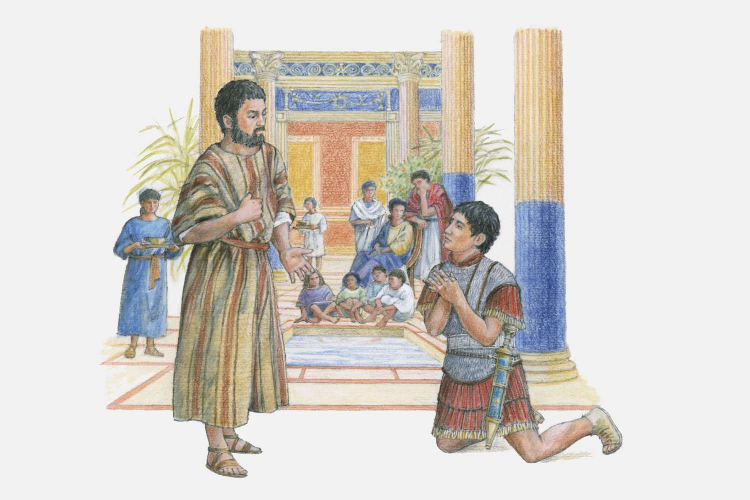
The Spirit Leads
Peter’s encounter with Cornelius marks a powerful turning point in history. It is not only a story of one group of Gentiles receiving the gospel. It is a revelation of the heart of God, a revelation that God’s kingdom includes people from all backgrounds and contexts. For Peter—a devout Jew shaped by cultural memory and prejudice—a vision on the rooftop prepared him to change his assumptions about who is acceptable to God. God was expanding the new covenant to people without regard to whether they were Jews or Gentiles.
God had actually been preparing this moment for generations. From the promise to Abraham, to the words of the prophets, to Jesus’ ministry among outsiders, we see evidence of God’s intention all along. The same Spirit who came in power upon the Jewish believers at Pentecost was now filling Gentiles—even a Roman centurion, whose rank is a symbol of imperial power.
The fact that Peter could recognize Cornelius as a full member of God’s family speaks to the transforming work of the Holy Spirit—not only in Cornelius’s life, but also in Peter’s. Peter began to see others the way God does, as beloved by God and invited into the family without reservation. This truth is echoed in Paul’s bold declaration in Galatians 3:28. The limitless reach of the gospel levels human division. In Christ, our ethnicity, gender, or status does not determine power or significance any more than the size of our bank account or social media following.
The Spirit is still preparing us, forming one new people—beloved and equal in God’s eyes. We are all commanded to follow in the footsteps of our Lord, declaring the gospel to our enemies and setting aside worldly evaluations of one another.
Always the Plan – click to expand
From the beginning, God’s redemptive plan has extended to every nation, not only Israel. His covenant with Abraham promised “all peoples on earth will be blessed through you” (Gen. 12:3). The Old Testament offers glimpses of this welcoming outsiders like Rahab and Ruth and proclaiming through Isaiah that “foreigners who bind themselves to the Lord . . . will be accepted” (Isa. 56:6-7). The prophet Joel foresaw a day when God would pour out His Spirit on “all people, Sons and daughters, old and young, even servants” (Joel 2:28-29). Jesus anticipated this inclusion. He praised the faith of Gentiles, spoke with women as disciples, and declared, “I have other sheep that are not of this sheep pen . . . and there shall be one flock and one shepherd” (John 10:16). Jesus lived in the reality of the kingdom. The boundaries of the early church’s worldview explode when the Spirit is poured out on Cornelius, a Roman centurion. What was foreshadowed in Scripture and in Jesus’ actions becomes reality for the church: God shows no favoritism, and His desire is to draw all people to Himself. In Christ, all are equal, beloved, and empowered members of one Spirit-filled family.Father, We know that You loved the world so much that You sent Your Son to save us. We’re grateful that You didn’t bring salvation for only one group of people. We ourselves are among those who benefit from Your worldwide gift of grace! Give us Your heart for the nations, that all people would hear and receive the good news that Jesus saves. Amen.
Week of March 9 through March 14
Something to think about this week: Living “openhanded” to the needs of others.
Daily Bible Readings
Mon. – Psalm 12 – God Will Defend the Needy.
Tue. – Luke 12:13-21, 33-34 – DO Not Be Afraid to Give.
Wed. – Leviticus 19:11-18 – Treat the Neighbor with Justice.
Thu. – James 2:8-13 – The Royal Law of Love.
Fri. – Luke 10:25-37 – Everyone Is Our Neighbor.
Sat. – Deuteronomy 15:4-11 – Compassion for Those in Need.
Next Week: Deuteronomy 15:4-11; Matthew 25:42-45

The invitation for this week asks everyone to consider the needs of the community. There are ways of supporting one another that go beyond financial giving, but we never want to limit the ways that God might ask us to serve others. Make this a season where you are openhanded to the people you meet.
Lesson 02 – March 15 – Giving to the Community
What Is Money For?
Think about some things people have used as currency in history: shells, beads, salt, gold, whale teeth, and now even cryptocurrency. At its core, money is a tool to convey value. Unless you are a collector, you value money because of what it promises: freedom, time, esteem, relaxation, and more.
We are always tempted to project value onto the possessors of money, but Jesus reforms our understanding of value. Being rich is not a mark of our worth, just as being poor is not a knock against us. When Jesus tells of a man who enjoys the status of riches, the man loses it all because he is not “rich toward God” (Luke 12:16-21). If money is to have value to Jesus’ followers, it is for what they use it to accomplish, who they are able to help, and what glory they bring to God.
We shouldn’t forget that money is a tool. We might have a goal to earn more, but the next goal should be to surrender it for God to use. After all, earthly riches are temporary; they pass from our control when we die. Heavenly treasures last forever: faith, relationships, the love we show (Matt. 6:19-21). More money doesn’t signal spiritual success. But what we do with it is surely relevant.
As individuals, we can’t make ourselves responsible for every need we encounter. But as a community that follows a just God, generosity should be a distinctive act of worship.
Click to expand Discussion Questions
1 Imagine you were given a 150% raise at work. What would you do?An answer to this question will depend upon the individual situation, but it can stretch us to consider. People love to say that they would give a windfall of new money to charity or to helping family, but this might only be what we wish we would do! We should remember Jesus’ words of warning, that it is more difficult to enter the kingdom as a rich person. This is because the more we steward, the more difficult it can be to demonstrate costly generosity.
2 Where have you seen someone valued according to how much money they have?
This question could go either way. It might be that wealthy people who join a community are treated with extra respect and favor, receiving a special seat at the table. Likewise, we might see people without resources who are looked down upon or taken for granted.
3 Has your church community been known for generosity? How?
The community of Christ’s followers is asked to support the needs in their midst. You may have seen churchgoers receive special support during difficult seasons. Churches often come together for young parents, aging elders, and people who are sick. The way that church members support one another (and also outsiders) is a direct witness to the wider world. It is worth celebrating!
Heavenly Father, We want to see the people in our world with Your perspective. Give us Your eyes to see those in need around us. Give us Your compassion for their suffering. Help us to resist the temptation to judge but rather become people of love, empathy, and understanding. Amen.
Week of March 2 through March 7
Something to think about this week: Our habits
Daily Bible Readings
Mon. – Proverbs 12:1-2, 10-14 – Work and Discipline.
Tue. – 1 Corinthians 6:12-20 – The Temple of the Body.
Wed. – 1 Corinthians 9:19-27 – The Discipline of Right Choices.
Thu. – Psalm 139:1-12 – God Is Always with Me.
Fri. – Psalm 139:13-24 – Fearfully and Wonderfully Made.
Sat. – 1 Timothy 4:7-12 – The Superior Training in Godliness.
Next Week: Daniel 1:8-17; 1 Timothy 4:7-8

Lesson 01 – March 8 – Watching Our Consumption
Daniel and his three friends, Hananiah, Mishael, and Azariah, were taken to Babylon from their home country of Judah. They didn’t ask for this fate. For many years, Judah was weakened and corrupted by inadequate kings. God allowed Babylon to lay siege to Jerusalem and to send many people into exile.
Daniel and his friends are young and capable, which is why they have been chosen for future service in the courts of King Nebuchadnezzar. They would learn the language and customs of Babylon. Over time, their identities are expected to shift and to change, and they receive new Babylonian names to match.
These servants-in-training are fed well, with food and wine from the king’s own table. Their position is meant to help them adapt to new lives, exiled far from their homeland and families. For three years, they would be apprenticed in this role.
But in verse 8, Daniel makes a hard decision: not to “defile himself” with all these fancy things to eat. It could mean several things. Perhaps the food did not fit the requirements of Israel’s covenant agreement. Alternatively, the royal food might have been offered to idols and false gods. Or, perhaps Daniel notices that accepting rich food would signal disloyalty to his people, who were struggling and starving. Whatever the reasons, Daniel wants to remain a faithful servant of the one, true God. By taking a stand, he invites his friends to join his commitment to faithfulness.
Even as a slave in the court of a foreign king, Daniel is treated with respect by the chief official. He lives in such a way that others notice and show “favor and compassion.” But the king’s chief official is concerned that Daniel and his companions will look thin and unhealthy if they eat only vegetables and water.
Thus Daniel devises a test. He and his friends shall eat this restrictive diet for ten days, after which time their appearance can be compared to the rest. If these exiles of Judah remain faithful to God, they expect God to be faithful in return, meeting all of their needs.
The four men pass their self-devised test. At the end of ten days of eating a restrictive diet in the Babylonian court, they appear healthier than all the rest. God’s faithfulness goes beyond preserving their physical health: they receive great “knowledge and understanding.” And Daniel is singled out for his ability to interpret “visions and dreams.”
Because the exiles do not depart from faithful living, God helps them succeed in other things. Like other ancient people, the Babylonians see dreams as powerful messages from the gods. Their people seek to understand dreams through divination, but Daniel has this gift of interpretation from the one, true God. He can use his skill for the success of his new home. But while living in Babylon, he and his friends shall not lose their identity as God’s servants.
Click to expand Discussion Questions
1 What are examples of things that we can consume that are not beneficial for us?We know that junk food is not beneficial and will leave us depleted, rather than filled. But if we are thinking about our diet of entertainment, like the writer of this devotion, we might choose to restrict our use of social media, which is designed to capture more and more of our attention. Even more destructive are habits like drugs, gambling, or viewing pornography—all hazardous to our spiritual health.
2 What can cloud our judgment about what is good?
Most destructive choices are compelling because they promise something good. Social media can promise attention and connection to others, but it overwhelms users with negative thoughts and provocative stories. We are clouded by the pressure to conform and to go along with what seems good to others.
3 How might you choose to live in the world, without compromising your values?
Christians have always been challenged to answer this. Like Daniel and his friends, we don’t have the option to “opt out” and not participate in our culture. God has placed us in a particular set of circumstances, and we honor that call by abiding with Him. But when we are uncertain of where to draw the line, we should bring it to God in prayer.
Evaluating Our Consumption
In an imperfect world, there are any number of ways that our habits of consumption might not be surrendered to God. By paying attention to our habits, we can honor Him in our daily living.
Jesus, We want to live our lives in ways that honor You. Reveal to us the areas where our habits are out of line with Your character. Give us courage and perseverance to make the adjustments that are necessary. Thank You that when we backslide, Your amazing grace covers us and draws us back to what is true and nourishing. We love you. Amen.

